
Innovative Road Pricing Experiment: Mileage Fee vs. Congestion Charge
E N D
Presentation Transcript
Road Pricing Anthony M. RufoloSystems Science Seminar May 7,2010
Perceived Need To Replace Fuel Taxes • Concern About Alternative Fuel Vehicles • Current Revenue Not Adequate • Resistance To Fuel Tax Increases • Pricing Could Help Manage Demand • But Imposing Prices Is Costly
Mileage Fee Experiment • Oregon Department of Transportation (ODOT) Tested a System to Replace State Gas Tax With Mileage Fees • When Fueling at a Participating Station, System Subtracts Gas Tax And Adds Mileage Fee • Other Vehicles Still Pay Gas Tax
Basic System • GPS Used To Allow On Board Unit To Determine Time And Location Of Travel • Up To 30 Time And Location Zones • All Miles Driven Allocated To A Zone • Could Be Different Fee For Each Zone • All Data Stored In Vehicle
Data Transfer • When Fueling, Vehicle Communicates With Pump Via Radio Signal • In Baseline, Mileage Data By Zone Uploaded • In Experiment, State Gas Tax Deducted And Mileage Fee Added At The Pump
Baseline • Two Service Stations Equipped With Technology • Volunteers Recruited Who Lived Or Worked Near The Stations • Vehicles Equipped With Devices • Approximately 4.5 Months Of Baseline Data Collected On Driving By Zone • Participants Instructed To Regularly Use Participating Stations
Experiment • At Midpoint, Participants Assigned To One Of The Three Groups • Data Collected For About Another 4.5 Months • For Experiment Groups, Gas Tax Deducted And Mileage Fee Added At Participating Stations • Participants Were Reimbursed For State Gas Tax Paid At Other Stations
Objectives • Test Functioning Of Equipment In Vehicles And At Pumps • Identify Problems With Using The System For Users Or Stations • Evaluate Behavioral Responses To Flat VMT Fee • Evaluate Behavioral Responses To Congestion Pricing
Not Random • The Sample Was Not Random • All Volunteers • Must Be Able To Fuel At Participating Stations At Least Twice Per Month • All Vehicles In Household Must Participate And Be 1996 Or Newer • $300 Or More Per Vehicle In Incentive Payments • No Motorcycles Or Diesel Vehicles In Household
Volunteers Recruited • Installation Of On Vehicle Devices Occurred Between June 14,2006 and July 11, 2006 • Initial Sample Was 201 Households • But Useable Data From 168 Households With 207 Vehicles
Experiment Begins • In November 2006, Households Were Assigned To One Of The Three Experiment Groups: Control, Mileage Fee (VMT), Or Congestion Pricing (RH) • Given An Endowment Account Based On Baseline Driving And Price System • Mileage Fees Deducted From Endowment And Any Remainder Paid At End
VMT Fee • The Basic System Tested Was A Simple Vehicle Miles Traveled (VMT) Fee • Charge of 1.22 Cents Per Mile Traveled In Oregon (On Average Equal To State Gas Tax) And Refund Of Gas Tax • No Charge For Miles Outside Of Oregon • No Refund Of Other State Gas Taxes
Congestion Charge • Value Pricing Program Provided Funding And Congestion Charges Added As Part Of Test • 10 Cents Per Mile For Travel In Congestion Zone During Weekday Rush Hours (7-9 a.m., 4-6 p.m.) • 0.43 Cents Per Mile For Other Travel In Oregon
Control Group • No Change From Baseline-Continue To Fuel At Stations But Pay Price Including State Gas Tax • Intended To Control For Seasonal Effects, Changes In Price Of Gasoline, And So On
Data Collection Design • Mileage By Zone Collected Whenever Vehicle Was Fueled At A Participating Station • Data Collected At Independent Reader Station To Mark Beginning, Midpoint, And End Of Study
Data Collection Reality • Reported Reads Varied Between 66% And 88% Of Detected Vehicles By Station By Month During Baseline • Could Be Problems With Data Transmission, Drive By, Or Stop For Other Purchases • Problems With Independent Reader Either Due To Failure To Try Or Failure To Transmit Data
Problems Created • Less Than Half Of Control Group Provided Useable Data • Vehicles Spent Varying Amounts Of Time In Baseline And Experiment • New Change In Daylight Savings Time Was Not Programmed Into The Units, So Rush Hour Changed On March 11, 2007
Responses To Problems • Data Calculated As Miles Per Day And RH Miles Per Weekday To Account For Varying Times Of Participation • Data Analyzed For Experiment Ending On March 11, 2007 And For Experiment Ending On April 1, 2007 • Data Analyzed By Vehicle And By Household
Group Size • Control Group Was Intended To Be 27 Vehicles (About 10%), But Only 10 Provided Useable Data • VMT Group Ended With 95 Vehicles Providing Useable Data • RH Group Ended With 102 Vehicles Providing Useable Data • Control Group Results Not Statistically Significant
Results • VMT Reduced Mileage Relative To Control But Increased Rush Hour Mileage • Not Statistically Significant, But Survey And Focus Groups Found Participants Stating That They Reduced Mileage
Congestion Pricing Results • Paired Means Shows About 13% Reduction In Peak Miles • Further Reduction In Off-Peak Miles Rather Than A Shift To Off-Peak • Reflects A Pure Price Effect Since There Was No Change In Congestion For This Group
Effect Of Price On Mode Choice • 12 Of 84 Households In RH Reported Someone In Household Changing Mode To Save Money • 10 Of 79 Households In VMT Reported This As Well Although On Average The VMT Fee Was Equal To The Gas Tax
Effect Of Congestion Charge On Travel • 26 Of 84 RH Households Reported Changes In Either Time Or Distance Traveled • 23 By Avoiding Driving During Rush Hour • 4 Reported Consolidating Trips And One Joined A Carpool
Response To Fee System • 145 of 163 Households (91%) Would Be Willing To Stay With System If All Service Stations Participated • Response Drops To 105 (64%) Who Think Other People Would Be Willing To Use The System
Caveats • Self-Selected Sample • Effects Of Being In An Experiment • Limited Duration • Congestion Price Is Per Mile But Does Not Reflect Direction Of Travel Or Other Differences In Actual Congestion
Accuracy • OSU determined that readings from system deviated as much as 20% from odometer readings • Some problems with zone boundaries • Many missed reads at the pump
Cost • Retrofit would be expensive, so phase in with new vehicles • Change station accounting software • Equip pumps • Accounting and billing system
Potential Use of Road Pricing • Two Congressional Commissions Have Recommended Replacing Fuel Taxes With Pricing • But The Cost of Pricing is Much Higher Than the Cost to Collect Fuel Taxes
Many Types Of Pricing • Targeted Tolling and Pricing • Turnpikes • Bridges, Tunnels, And Related Links • Cordon Pricing • Comprehensive Pricing • Flat Charge • Variable Based On Congestion, Emissions, Road Damage
Cost Issues • Few Taxpayers Pay The Fuel Tax, But There Could Be Millions Of Accounts With Pricing • Technology May Be Costly • Cost To Manage Accounts And Enforce The System • Research Needed To Better Understand Cost Trends And Possibilities To Use Technology Available For Other Purposes
Tolls With Closed System • Tolls paid at designated areas with barriers to entry/exit • Detection by toll gates, attendants, police, and cameras • Advantage is low violation rates • Disadvantages are cost, bottlenecks, and safety issues
Tolls With Open System • Vehicles equipped with transponders and tolls are paid as the vehicle passes through • Detection is mostly cameras • Advantage is higher throughput and revenue generation • Disadvantages are higher violation rates and costs for transaction recognition, violation processing, and courts
Automatic Vehicle Identification • Identify vehicles at fixed points • Wireless data/financial transaction via transponder/tag • Toll roads, tunnels, bridges, cordons • Video recognition of license plates for enforcement • London using high speed license plate matching only (no tags) for cordon pricing
Tolling in U.S. • 277 toll roads, bridges, or tunnels • $9.3 billion in toll revenue in 2006 • Operating costs tend to be a high percentage of revenue
Flat Versus Variable Pricing • Tolls That Do Not Vary Raise Revenue But Do Not Manage The Road System • Prices Based On The Level Of Congestion Manage The Road System, But May Not Raise Desired Revenue
Types Of Congestion Charges • Congestion Charge Varied By Time, Location, And Distance Traveled Is Most Efficient • Dutch Have Proposed Such A System, But None Currently Exist • Facility And Area Systems Have Been Implemented
Variable Toll Facilities • Growing Experience With High Occupancy Vehicle/Toll (HOT) Lanes • Generally Used For New Lanes Or Underutilized HOV Lanes • Static And Dynamic Congestion Pricing Is Used • Some Use Of Variable Pricing On Previously Flat Toll Facilities
Cordon or Area Pricing • In use in other countries • Singapore • London • Stockholm • Proposed for New York, but not implemented
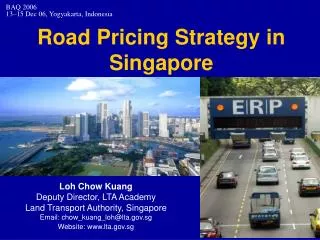
Cordon Pricing: Singapore Demand management Initially, paper based system with 31 checkpoints in morning peak hours Expanded to 66 gantries, 7:30 am to 4:30 pm ERP system implemented Vehicle transponders Smart cards Electronic gantries OCR license plate recognition Variable dynamic pricing 85th percentile speed, 45 to 65 km/h
£5/vehicle; increased to £8/vehicle Area expanded in 2007 No barriers/tollbooths Residents: 90% discount £1/vehicle discount for fleets with 10+ vehicles Weekly, monthly, and annual passes. £120 fine; reduced to £60 if paid in 2 weeks Free passage route Cordon Pricing: London Original Western Extension
Comprehensive Pricing • History • Oregon experiment • Puget Sound experiment • Others
Most Proposals Rely On GPS • Must Locate Where Vehicle Is Operated And Mileage • Odometer Based Subject to Fraud and Costly • Cell Towers is Another Possibility
Telematics GPS + Primary Cellular, Combination Antenna Emergency Call Button Information Button Telematics Control Unit Roadside Assistance Button Protected Backup Antenna