AGING AND THE CIRCADIAN CLOCK
100 likes | 225 Vues
This article examines the relationship between aging and circadian rhythms, highlighting paths of neuronal survival and degeneration. Key hypotheses suggest that caloric restriction (CR) may protect rhythmicity in aging mice and that the deterioration of circadian clocks correlates with neurodegeneration. The research involves comparing different genetic and dietary mouse models to assess the impact on neuronal activity and circadian function. Additionally, the role of SIRT1 activation in the suprachiasmatic nucleus (SCN) neurons as a potential mitigator of circadian dysfunction is explored.


AGING AND THE CIRCADIAN CLOCK
E N D
Presentation Transcript
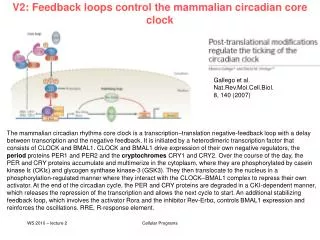
AGING AND THE CIRCADIAN CLOCK DENNIE KIMMCB18613 DECEMBER 2006
LEVELS OF CONTROL CHOU ET AL., 2003. J. NEURO 23(33)
CR, SIRT1, and NEURONAL CELL SURVIVAL B.L. Tang, 2006. Neurobiology of Aging 27 (503)
DETERIORATION OF BIOLOGICAL RHYTHMS NEURODEGENERATION ? Bentivoglio et al. 2006
DETERIORATION OF BIOLOGICAL RHYTHMS Hofman et al., 2006
NOT JUST IN THE SCN? M. HOFMAN, 2000.
Hypothesis 1: CR mice are protected from degeneration of rhythmicity. • Calorie restrict miceCONTROL(S): NORMAL DIET MOUSE, RESVERATROL-TREATED MOUSE, SIRT1-K/O MOUSE • Measure rhythms/neuronal activity • Test entrainment
Hypothesis 2: Deterioration of Circadian Clock is a Problem of Neurodegeneration • If neurons of the SCN (or DMH/VLPO) die during aging, the number of connections made should decrease. • Use retrograde/anterograde tracers to label neuronal connections in young and old mice. • Similarly, compare old mice to CR “old” mice.
Hypothesis 3: SIRT1 Activation in SCN Neurons Can Prevent Circadian Dysfunction. • Create an temporally/transiently SIRT1-inducible transgenic mouse. • Measure rhythms/SCN-neuronal activity compared to wt mouse. • Western blot/In situ hybridization/Immunohistochemistry to show increased levels of SIRT1 in transgenic mouse.