Download
1 / 9
90 likes | 204 Vues
This text explores the key agents of evolutionary change, including mutation, gene flow, non-random mating, and selection. It provides a hypothetical framework for understanding populations that adhere to Hardy-Weinberg equilibrium, serving as a model for non-evolving scenarios. The discussion includes examples of evolutionary pressures, such as Tay-Sachs disease and sickle cell anemia, emphasizing concepts like heterozygote advantage and the impact of natural selection in specific environments. The importance of genetic diversity and survival advantages within populations is highlighted.

E N D
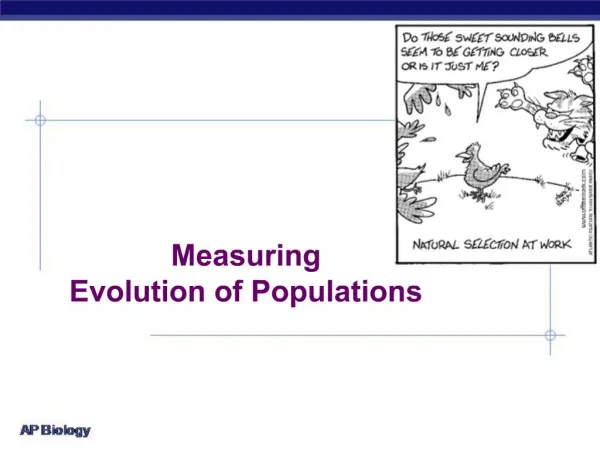
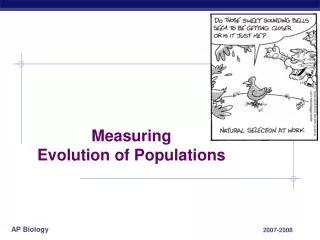
5 Agents of evolutionary change Mutation Gene Flow Non-random mating ChemicalChanges to DNA Migration Sexual Selection Genetic Drift Selection Natural SelectionDifferential Survival Small population
Hardy-Weinberg equilibrium • Hypothetical situation • serves as null hypothesis • non-evolving population REMOVE all agents of evolutionary change • no genetic drift(very large population size ) • no gene flow (no migration in or out) • no mutation (no chemical change to DNA) • random mating (no sexual selection) • no natural selection (equal survival)
Example of strong selection pressure • Tay Sachs • primarily in Ashkenazi Jews & Cajuns • recessive disease = aa • lysosomal storage disease • lack of one functional digestive enzyme in lysosome • build up undigested fat in brain cells • children die before they are 5 years old So where do new cases of Tay-Sachs come from?
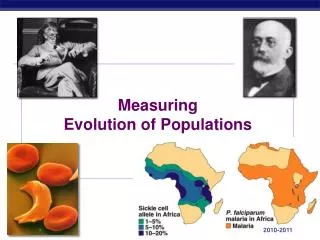
Example of heterozygote advantage • Sickle cell anemia • inherit a mutation in gene coding for one of the subunits in hemoglobin • oxygen-carrying blood protein • normal allele = Hb • mutant allele = Hs • recessive trait = HsHs • low oxygen levels causes RBC to sickle • clogging small blood vessels • damage to organs • often lethal
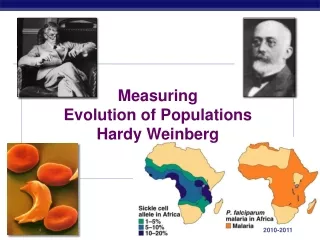
Sickle cell frequency • High frequency of heterozygotes • 1 in 5 in Central Africans = HbHs • unusual for allele with severe detrimental effects in homozygotes • 1 in 100 = HsHs • usually die before reproductive age Why is the Hs allele maintained at such high levels in African populations? Suggests some selective advantage of being heterozygous… HbHs
Malaria Single-celled eukaryote parasite (Plasmodium) spends part of its life cycle in red blood cells 1 liver 2 3
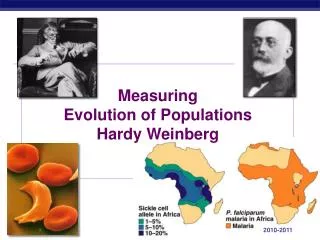
Heterozygote Advantage • In tropical Africa, where malaria is common: • homozygous dominant (normal) • reduced survival or reproduction from malaria: HbHb • homozygous recessive • reduced survival & reproduction from sickle cell anemia: HsHs • heterozygote carriers • survival & reproductive advantage: HbHs Hypothesis: In malaria-infected cells, the O2 level is lowered enough to cause sickling which kills the cell & destroys the parasite. Frequency of sickle cell allele & distribution of malaria
Any Questions?? Any Questions?? Any Questions??