Enhancing Institutional Research: Metrics, Trends, and Student Insights
The institutional research office plays a vital role in advancing educational effectiveness through data analysis and reporting. This comprehensive overview encompasses the purpose, structure, and key metrics, including admissions funnels, enrollment data, and student demographics. By evaluating accountability and performance measures, we identify common indicators of institutional effectiveness. Additionally, we explore retention and graduation rates through longitudinal and cross-sectional trends, showcasing annual fact books and surveys that provide insights into student satisfaction and alumni outcomes. Continuous growth in data requests emphasizes the increasing need for effective research in guiding university strategies.

Enhancing Institutional Research: Metrics, Trends, and Student Insights
E N D
Presentation Transcript
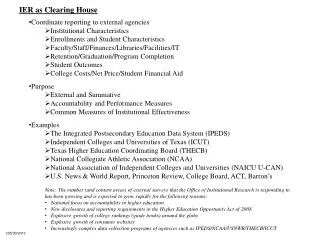
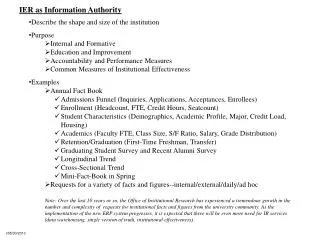
IER as Information Authority • Describe the shape and size of the institution • Purpose • Internal and Formative • Education and Improvement • Accountability and Performance Measures • Common Measures of Institutional Effectiveness • Examples • Annual Fact Book • Admissions Funnel (Inquiries, Applications, Acceptances, Enrollees) • Enrollment (Headcount, FTE, Credit Hours, Seatcount) • Student Characteristics (Demographics, Academic Profile, Major, Credit Load, Housing) • Academics (Faculty FTE, Class Size, S/F Ratio, Salary, Grade Distribution) • Retention/Graduation (First-Time Freshman, Transfer) • Graduating Student Survey and Recent Alumni Survey • Longitudinal Trend • Cross-Sectional Trend • Mini-Fact-Book in Spring • Requests for a variety of facts and figures--internal/external/daily/ad hoc • Note: Over the last 10 years or so, the Office of Institutional Research has experienced a tremendous growth in the number and complexity of requests for institutional facts and figures from the university community. As the implementation of the new ERP system progresses, it is expected that three will be even more need for IR services (data warehousing, single version of truth, institutional effectiveness). ir05/30/2013