Exploring Solar Energy: The Sun, Shadows, and Their Impact on Our Lives
50 likes | 172 Vues
Discover the amazing role of the Sun as the primary energy source for Earth and its contributions to processes like the water cycle and fossil fuel formation. Learn about how solar energy is harnessed for heating, cooking, and even powering spacecraft. This investigation also explores the nature of shadows, how they are created by both natural and artificial light, and the effects of the Sun's changing position throughout the day. Delve into key vocabulary such as spectrum, radiation, and the concepts of umbra and penumbra in understanding light.


Exploring Solar Energy: The Sun, Shadows, and Their Impact on Our Lives
E N D
Presentation Transcript
Solar Energy Investigation 1 – Sun Tracking
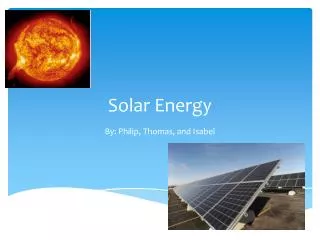
Part 1 – Shadow Play Main Ideas/Content • The Sun • The Sun is a star that is the source of most of the energy on Earth. • Energy from the Sun reaches us as heat and light. • Moonlight, as well as wind, are caused by the Sun. • The Sun also contributes to the water cycle and the formation of fossil fuels.
Part 1 – Shadow Play • People collect solar energy and use it to heat homes, run machines, cook food, etc. It is also used to power spacecraft. • The Sun is made up mostly of hydrogen, but also helium. • Scientists measure the Sun’s light, heat, and radio waves from Earth using telescopes and satellites; they use space probes in space.
Part 1 – Shadow Play • Shadows • Shadows are created when any type of light shines. • Opaque objects, like bodies, block light from the Sun, creating a shadow behind the object. • Shadows have two different levels of darkness. • Shadows created by artificial light change more than shadows created by sunlight. • Shadows change during the day because the position of the Sun changes.
Part 1 – Shadow Play Vocabulary Words • Spectrum – pattern of colors that make up the Sun’s light • Radiation – energy particles • Shadow – the dark area created by an object that stops light • Orientation – a position or arrangement in relation to another position or location • Umbra – darker area in the middle of a shadow • Penumbra – lighter area around the edges of the shadow