Landmark Constitutional Cases: Marbury v. Madison and United States v. Nixon
120 likes | 304 Vues
Explore the pivotal Supreme Court cases of Marbury v. Madison and United States v. Nixon that defined the power dynamics within the U.S. government. Marbury v. Madison established the principle of judicial review, allowing the Supreme Court to declare laws unconstitutional. United States v. Nixon examined issues of presidential power and executive privilege during the Watergate Scandal, ultimately leading to Nixon's resignation. These cases fundamentally shaped American law and governance, reinforcing the supremacy of the Constitution and limiting presidential authority.


Landmark Constitutional Cases: Marbury v. Madison and United States v. Nixon
E N D
Presentation Transcript
MT. 3, LT. 2: Landmark Constitutional Cases Landmark Constitutional Cases Marbury v. Madison Establishing Judicial Review
Background of Case ??? Arguments Arguments Impact of Case
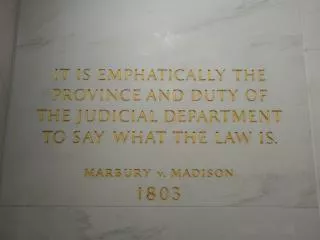
Key Concept • Marbury v. Madison – established principle of judicial review (not actually mentioned in the Constitution) • Supreme Court could check the power of the other two branches by: declaring laws and actions unconstitutional
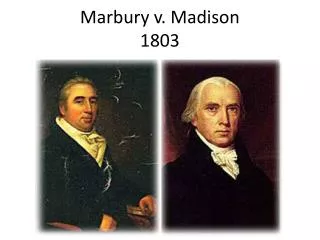
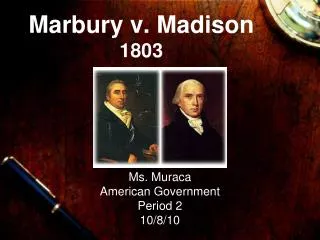
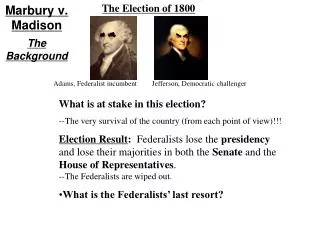
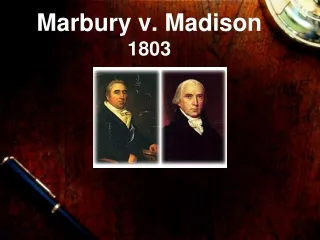
Key People • John Adams – outgoing president • Thomas Jefferson – incoming president • William Marbury – last minute judicial appointment • James Madison – Jefferson’s Secretary of State
Key Terms • Judiciary Act of 1789: • Created a federal court system • Empowered the Supreme Court to issue writs of mandamus • Writ of Mandamus = court order that forces a government official to perform their legal duties
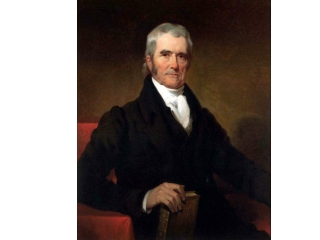
John Marshall • Chief Justice of the Supreme Court • Main goal – strengthen the power of the Judicial Branch • Main belief – it is the power of the Courts to interpret or decide what the law means
MT. 3, LT. 2: Landmark Constitutional Cases McCulloch v. Maryland & United States v. Nixon Establishing Constitutional Supremacy Limiting Presidential Power
McCulloch v. Maryland – Some Questions • Could Congress create a national bank to help with taxation, borrowing money, and regulate commerce? • Could a state pass a law taxing that national bank?
Key Concepts – Elastic Clause • “Elastic Clause” – Congress has the power to make all laws that are necessary and proper to carry out its duties • Congress could expand its powers if necessary – “implied powers”
McCulloch v. Maryland – Constitutional Questions • Supremacy Clause – the Constitution was the “supreme Law of the Land” • Federal law was superior to state law
United States v. Nixon:Some Background • Watergate Scandal – break in at the Democratic National Headquarters • Richard Nixon – President of the United States (possibly involved in planning the break-in then trying to cover up his involvement)
Key Concepts • White House taping system – possible evidence of Presidential involvement in the break-in and cover up • Executive Privilege – the right of the President to keep White House discussions and documents private • Resignation – led to Nixon becoming the only President to resign his office