Understanding Structures and Pointers in C Programming
This guide explores the fundamentals of structures and pointers in C programming. It covers how to define structures, access structure members, and manage memory allocation. Key examples illustrate the use of the `offsetof` macro to determine the offsets of structure members. Additionally, you'll find detailed syntax for working with structures and pointers, including dynamic memory allocation using `malloc`. Learn how to define custom data types with `typedef` and efficiently manage data in your C applications.

Understanding Structures and Pointers in C Programming
E N D
Presentation Transcript
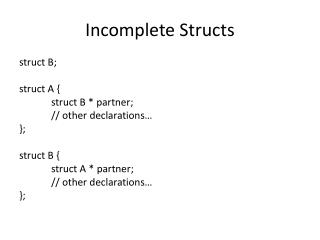
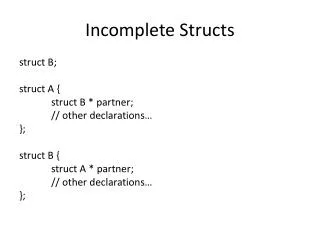
Incomplete Structs struct B; struct A { struct B * partner; // other declarations… }; struct B { struct A * partner; // other declarations… };
Structs and pointers struct S { inta; char* b; } myS; // pointer to a struct struct S * sp; // pointer to a struct data member Determine the address of a or b
Pointers and struct data members • offsetof(<type>,<member>) • Gives the offset of a variable within a structure (function in stddef.h) struct S { int a; char* b; } myS; char* pb = (char*)&myS + offsetof(struct S, b);
Struct and pointer syntax example #include<stdio.h> typedefstruct{ char *name; intnumber; } TELEPHONE; intmain(){ TELEPHONE index; TELEPHONE *ptr_myindex; ptr_myindex= &index; ptr_myindex->name = "Jane Doe"; ptr_myindex->number = 12345; printf("Name: %s\n", ptr_myindex->name); printf("Telephone number: %d\n", ptr_myindex->number); return 0; }
Another Struct and pointer syntax example (also with allocation) #include<stdio.h> typedefstruct { inti; float PI; char A; } RECORD; int main() { RECORD *ptr_one; ptr_one= (RECORD *) malloc (sizeof(RECORD)); (*ptr_one).i = 10; (*ptr_one).PI = 3.14; (*ptr_one).A = 'a'; printf("First value: %d\n",(*ptr_one).i); printf("Second value: %f\n", (*ptr_one).PI); printf("Third value: %c\n", (*ptr_one).A); free(ptr_one); return 0; } Note: if the struct contains a pointer you may have to allocate memory for that with a second malloc call