
Differential Brain Activation in Response to Familiar vs. Non-Familiar Voices During Story Reading
This study investigates the differences in brain activation when participants listen to stories read by familiar voices (FV) compared to non-familiar voices (NFV). Results show significant differential activation patterns across the whole brain, particularly highlighting 52 voxel clusters that are more active during FV readings. These findings contribute to the understanding of auditory sensory processing and suggest potential applications for auditory training in therapeutic settings, particularly for individuals recovering from coma.

Differential Brain Activation in Response to Familiar vs. Non-Familiar Voices During Story Reading
E N D
Presentation Transcript
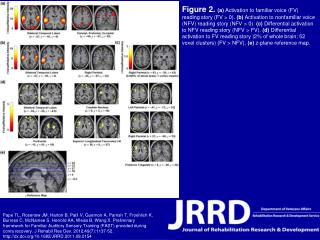
Figure 2. (a) Activation to familiar voice (FV) reading story (FV > 0). (b) Activation to nonfamiliar voice (NFV) reading story (NFV > 0). (c) Differential activation to NFV reading story (NFV > FV). (d) Differential activation to FV reading story (2% of whole brain; 52 voxel clusters) (FV > NFV). (e) z-plane reference map. Pape TL, Rosenow JM, Harton B, Patil V, Guernon A, Parrish T, Froehlich K, Burress C, McNamee S, Herrold AA, Weiss B, Wang X. Preliminary framework for Familiar Auditory Sensory Training (FAST) provided during coma recovery. J Rehabil Res Dev. 2012;49(7):1137-52.http://dx.doi.org/10.1682/JRRD.2011.08.0154