Understanding Function Evaluation: Examples and Applications
This presentation covers the concept of evaluating functions using various examples. We begin by illustrating how to replace a variable in a function with a specific value, such as finding f(-3) for f(x) = 5 - x², resulting in a calculated value of -4. We progress to evaluating expressions like f(a) for different forms, demonstrating how to derive formulas in terms of variables instead of specific numerical values. Finally, we explore piecewise functions, showing how to determine values based on domain constraints.

Understanding Function Evaluation: Examples and Applications
E N D
Presentation Transcript
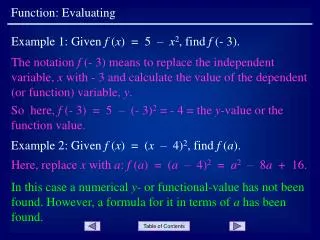
Function: Evaluating Example 1: Given f (x) = 5 – x2, find f (- 3). The notation f (- 3) means to replace the independent variable, x with - 3 and calculate the value of the dependent (or function) variable, y. So here, f (- 3) = 5 – (- 3)2 = - 4 = the y-value or the function value. Example 2: Given f (x) = (x – 4)2, find f (a). Here, replace x with a: f (a) = (a – 4)2 = a2 – 8a + 16. In this case a numerical y- or functional-value has not been found. However, a formula for it in terms of a has been found.
Function: Evaluating Example 3: Given f (x) = x2 + 2x, find f (a + h) – f (a). Here f (a + h) means to replace x with a + h so f (a + h) = (a + h)2 + 2(a + h),f (a + h) =a2 + 2ah + h2 + 2a + 2h, and f (a) means to replace x with a so f (a) = a2 + 2a. To findf (a + h) – f (a), subtract the expressions in yellow above to get: a2 + 2ah + h2 + 2a + 2h – (a2 + 2a), so f (a + h) – f (a) = 2ah + h2 + 2h. Here, the difference between the y-value when x = a + h and the y-value when x = a has been found. Slide 2
Example 4: Given find f (2). Function: Evaluating This function is defined in two pieces. One piece is f (x) = x2. It is defined only for x-values that are 3. The other piece is f (x) = x + 6. It is defined only for x-values that are > 3. Since the function is being evaluated for x = 2 and 2 3, the top piece f (x) = x2 is used. Therefore, f (2) = (2)2 = 4. Slide 3
Function: Evaluating END OF PRESENTATION Click to rerun the slideshow.