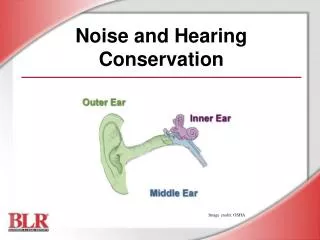
Noise and Hearing Conservation
280 likes | 534 Vues
Noise and Hearing Conservation. Image credit: OSHA. Session Objectives. You will be able to: Understand the effects of noise on hearing Identify sources of noise in your workplace Describe the purpose of audiometric testing and be able to interpret your test results


Noise and Hearing Conservation
E N D
Presentation Transcript
Noise and Hearing Conservation Image credit: OSHA
Session Objectives • You will be able to: • Understand the effects of noise on hearing • Identify sources of noise in your workplace • Describe the purpose of audiometric testing and be able to interpret your test results • Select, fit, and use hearing protection
What Is Sound? • Sound is a longitudinal pressure wave of energy with the following characteristics: • Frequency (pitch) measured in hertz (Hz) • Pressure (loudness) measured in decibels (dB) • Frequency and pressure of a sound wave with duration of exposure determine the risk of hearing loss
Noise Sources • Machinery, tools, and equipment emit sounds of varying loudness and in particular frequencies • Continuous or intermittent • Low-frequency equipment noise sources cause hearing loss in the speech frequencies
Sound Pressure Levels ofCommon Noises • Noise Source Loudness • Whisper 10 dB • Conversation 65 dB • Shop tools 90 dB • Pneumatic drill 100 dB • Woodworking shop 110 dB • Abrasive blasting 115 dB • Jackhammer 130 dB
OSHA Noise Exposure Limits • 90 dBA TWA for 8-hour exposure • 95 dBA TWA for 4-hour exposure • 100 dBA TWA for 2-hour exposure • 105 dBA TWA for 1-hour exposure • Use engineering controls, administrative controls, and personal protective equipment (hearing protection) to meet standards
Indicators of High Noise Levels • Noisy conditions can make normal conversation difficult • 80 dB–People have to speak very loudly • 85-90 dB–People have to shout • 95 dB–People have to move close together to hear each other at all
How Is Noise Hazardous? • Noise can result in temporary or permanent hearing loss • It can cause you to misunderstand communication • It can cause you to miss important safety warnings • It can create unhealthy stress
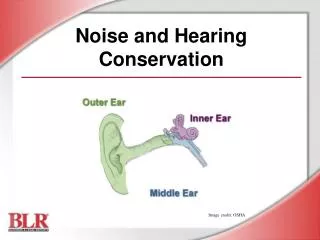
How We Hear Sounds • Sound waves enter the ear canal • Eardrum vibrations pass along tiny bones • Tiny hairlike cells flow back and forth • The auditory nerve sends signals to the brain that are registered as sound
How Hearing Is Damaged • Hearing ability relies on delicate parts that can be damaged in the inner and middle ear • Hairlike cells in the inner ear are flattened by high noise levels and injured over time • Hearing loss is gradual • Hearing damage is permanent Image Credit: OSHA
Hearing Loss • Hearing loss is any reduction in the ability to hear • Two types of loss • Temporary hearing loss (temporary threshold shift) may occur immediately following a high noise exposure • Permanent hearing loss (standard threshold shift)
Signs of Hearing Loss • Difficulty hearing people speak • Inability to hear certain high-pitched or soft sounds • Noise or ringing in ears • Getting complaints that the radio or TV volume is too high Image Credit: Tom Ouimet
Evaluating the Noise Exposure Hazard • Conduct a noise survey • Identify and characterize high-noise sources • Identify impacted employees • Monitor impacted employees • Repeat monitoring Image Credit: Tom Ouimet
Noise Hazards—Any Questions? • Do you understand • The hazards of excessive noise and how to identify them? • Signs and symptoms of hearing loss? • Measuring hearing loss?
Elements of the Hearing Conservation Program • All employees exposed to >85 dBA for 8 hours must participate • You receive: • Baseline and annual audiograms • Annual training on hearing loss • Hearing protection is provided • Exposure assessment conducted periodically
Audiometric Exams • Exams can detect early signs of hearing loss • Typically measures hearing threshold at six frequencies • Hearing thresholds are compared with previous audiograms
Standard Threshold Shift (STS) • Hearing loss has occurred if you have experienced a standard threshold shift (STS) • Hearing ability changed by an average of 10 dB • Revised hearing protection required for STS
Baseline Annual Has an STS Occurred? Image Credit: Tom Ouimet
An Example of Hearing Loss in Carpenters Image Credit: Tom Ouimet
Hearing Protection Use • Voluntary use if exposed to an 8-hour TWA of 85-90 dB • Mandatory use when: • Exposed to an 8-hour TWA of 90 dB • Exposed to an 8-hour TWA of 85 dB and have suffered an STS (hearing loss) or have not had a baseline hearing test
Hearing Protection Devices Noise Reduction • Hearing protection devices must reduce employee noise exposure below an 8-hour TWA of 90 dB • Employees with STS, noise exposure reduced below an 8-hour TWA of 85 dB • Noise reduction ratio (NRR) • Earplugs: use 1/3 of NRR • Earmuffs: use 1/2 of NRR
Hearing Protection Devices— Earplugs and Canal Caps • Must be properly inserted to seal the ear canal • Slowly roll and compress foam into cylinder • Insert into ear canal while compressed • Keeps noise from reaching the eardrum • Cotton is not an earplug Image Credit: State of WA-WISHA Services
Hearing Protection Devices—Earmuffs • Sealed against head with ears fully enclosed • Hair out from muffs • Glasses and caps do not interfere with seal • Headband adjusted so cushions exert even pressure • Cleaned with warm, soapy water and rinsed
Any Questions? • Do you understand • Audiometric testing? • Our hearing protection program? • When to use hearing protection? • Hearing protection devices?
Key Things to Remember • Hearing is a very important sense—don’t lose it • Noise exposure of 85 dB or more can cause hearing loss • Hearing loss cannot be cured or repaired • Hearing tests are conducted annually and can detect hearing loss • Hearing protection devices must be worn in high-noise areas