Exploring the Role of Computational Biologists in Genomic Data Analysis
30 likes | 128 Vues
Dr. Martin Tompa, a computational biologist at the University of Washington, develops algorithms to identify biological patterns, including genes and promoters, within DNA and protein sequences. With expertise in biology, mathematics, and computer science, he emphasizes the importance of these fields in bioinformatics. Computational biologists utilize computational methods and mathematical models to analyze complex biological data, making sense of the vast genomic information generated globally. The typical career path includes obtaining a PhD in computer science, with senior research scientists earning upwards of $150,000 annually.


Exploring the Role of Computational Biologists in Genomic Data Analysis
E N D
Presentation Transcript
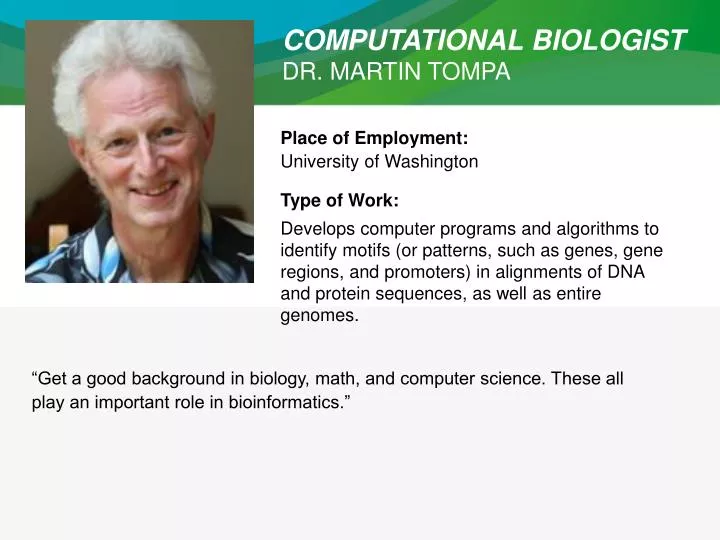
COMPUTATIONAL BIOLOGIST DR. MARTIN TOMPA Place of Employment: University of Washington Type of Work: Develops computer programs and algorithms to identify motifs (or patterns, such as genes, gene regions, and promoters) in alignments of DNA and protein sequences, as well as entire genomes. “Get a good background in biology, math, and computer science. These all play an important role in bioinformatics.”
CAREERS IN SPOTLIGHT:COMPUTATIONAL BIOLOGIST What do they do? Computational biologists develop and apply computer methods and mathematical models to study complex biological, behavioral, and social systems -- such as making sense of all of the genomic data being generated by scientists around the world. What kind of training is involved? A PhD in computer science or a related subject is required for most computer and information research scientist jobs. What is a typical salary for a Research Scientist? Ranges with experience. A senior professor might expect to make about $150,000 or more a year.
This program is made possible by National Science Foundation Innovative Technology Experiences for Students and Teachers grant award from the National Science Foundation, DRL-0833779