Understanding Impulse and Momentum in Physics
This chapter explores the concepts of impulse and momentum, fundamental principles in physics. Momentum is defined as the product of mass and velocity, and it can change when the velocity of an object changes, leading to impulse. The relationship between impulse and momentum is vital for analyzing collisions and the effects of forces over time. The chapter includes examples calculating momentum and impulse, examines conservation of momentum in different collision types, and how these concepts apply in real-world scenarios such as sports and vehicle safety.

Understanding Impulse and Momentum in Physics
E N D
Presentation Transcript
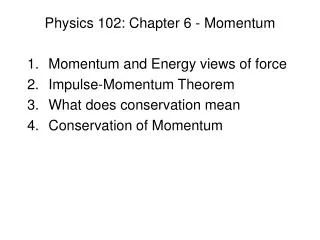
Physics Chapter 6 Impulse and Momentum
Momentum • Momentum depends on… • Mass • Velocity • Momentum = Mass x Velocity • The property of momentum… • Variable: p • Unit: • Scalar or Vector? • Equation: p = mv
Example#1 Which has more momentum, a 1-ton car moving at 100 km/h or a 2-ton truck moving at 50 km/h?
Example #2 How fast would a 18 kg kid on a tricycle have to go in order to have the same momentum as a 55 kg car traveling at 25 m/s?
F Impulse • Momentum can change. Most often, the mass of an object remains the same, while the velocity changes. • Dp = mDv • Dv acceleration a = Dv/t Dv=at • Dp = mDv becomes Dp = m x a x t • Dp = Force x time = Ft • This is called Impulse • I = Ft
Example #3 If a baseball bat applies a 22-N force to a baseball for 0.13 s, what is the impulse experienced by the ball?
Impulse & Momentum • Impulse equals a change in momentum • I = Dp • Variations Ft = mDv Ft = mvf – mvi I = mDv I = mvf – mvi Ft = Dp
Example #4 What is the impulse needed to stop a 10-kg bowling ball moving at 6 m/s?
Example #5 A car crashes into a wall at 25 m/s and is brought to a rest in 0.1 s. Calculate the average force exerted on a 75-kg test dummy by the seat belt.
Impulse & Momentum Increasing Momentum mDv = Ft Increase the time to increase the velocity • Examples: • Follow through in sports • Basketball shoot • Baseball hit • Soccer kick • Golf swing • Long-range cannons have long barrels
Impulse & Momentum Decreasing Force mDv = Ft Increase the time to decrease the Force • Examples: • Catching • Egg toss • Water balloon • Football • Cars: Crumple Zones & Air Bags • Roll with the punches • Mighty Ducks • Jumping and landing (sprung floors) • Running Shoes • Any padding • Bungee Jumping
Problems • Review Questions 1-11, 13 • Exercises 1-4, 6, 9, 10 • Problems 1, 2, 5
Conservation of Momentum • Newton’s Second Law… • If we want an object to accelerate, we must apply a force. • Impulse and Momentum… • If we want a change in momentum, we must apply an impulse. • In both cases, the force or impulse must be exerted on the object or any system of objects by something external.
Conservation of Momentum • If we define the system to include all the objects we want to study… all forces become internal; there can be no impulse; no impulse means no change in momentum! • When a physical quantity remains unchanged during a process, that quantity is said to be… CONSERVED.
Collisions • Momentum is conserved Momentum before = Momentum after • Three types of collisions… • Elastic objects rebound off each other without lasting deformation. • Inelastic objects are deformed by the collision; think car crashes. • Perfectly inelastic both objects stick together
v = 10 m/s v = 0 v = ? Example #1a The blue car is moving at 10 m/s, with a mass m. The orange car, also mass m, is at rest. If the freight cars are coupled together by the collision, what is their combined velocity?
v = 10 m/s v = ? v = 0 v = 0 Example #1b If the freight cars in the previous example do not couple and experience an elastic collision, what is the velocity of the orange car?
v = ? v = 10 m/s v = 0 Example #2 Two trucks with equal masses, m, experience a head on collision. After collision, the coupled wreck remains at the point of impact with zero momentum. If the green truck was moving at 10 m/s, how fast was the red truck moving?
Example #3 A 3 kg object traveling at 5 m/sec collides head-on with a 2 kg object that is traveling at 2 m/sec in the opposite direction. What is the velocity of the second object after the collision if the first object is moving at 1 m/sec?
Problems • Review Questions 18-23 • Exercises 13, 21 • Problems 6-10