Opportunities and Challenges in Floating Wind Energy: Insights from Eirik Byklum
100 likes | 243 Vues
This document explores the advantages and challenges of floating wind energy technologies, presented by Eirik Byklum. It discusses various foundation types for floating wind turbines, including spar buoys, semi-submersibles, and tension leg floaters, with a focus on their installation and environmental impacts. It highlights the differences between floating and bottom-fixed foundations, addressing cost reduction pathways for floating wind systems through design optimization, efficient fabrication, assembly, and installation. The future prospects of floating wind energy are optimistic, despite current higher CAPEX.


Opportunities and Challenges in Floating Wind Energy: Insights from Eirik Byklum
E N D
Presentation Transcript
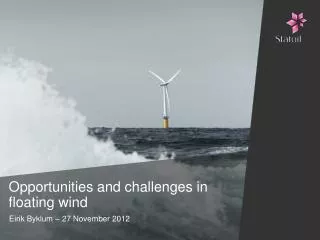
Opportunities and challenges in floating wind Eirik Byklum – 27 November 2012
Foundations for floating wind Spar buoys From 100 m water depth HywindDemo (2009) Semi-submersibles From 40 m water depth WindFloat Demo (2011) Tension leg floaters From 60 m water depth Scale test under planning
Installation Bottom-fixed foundations • Offshore installation of foundation • Offshore installation of WTG • Offshore commisioning Floating foundations • Inshore assembly • Tow-out of complete unit • Large part of commisioning onshore
Environment Bottom-fixed foundations • Piling noise during installation • Often in sight from land • Larger seabed footprint Floating foundations • No piling needed • Can be placed out of sight • Smaller seabed footpring
Fabrication and technology Bottom-fixed foundations • Adaption needed for each unit • Proven technology Floating foundations • Standardized, mass production • Less mature technology, need pilots
Main cost reduction areas for floating wind Concept development • Upscaling • Design optimization • Mooring systems Cost-efficient fabrication • Fabrication friendly design • Efficient mass production Assembly and installation • Efficient installation vessels • Onshore assembly
Conclusions Large offshore wind resources located in deep waters Floating wind has advantages in terms of fabrication, installation and environment Currently higher CAPEX, but cost-competitive in the future
Eirik Byklum Technology Manager Floating Wind ebyk@statoil.com www.statoil.com