Resource access control -- example
This document explores resource access control in real-time systems, focusing on tasks T2 and T3 accessing a shared resource R. It examines the duration of tasks before, during, and after entering the critical section, analyzing the impact of scheduling strategies like Rate Monotonic Scheduling (RMS). The study highlights the effects of priority inversion and direct blocking, showcasing scenarios where task T3 is preempted by T1 and blocked by T2. Techniques such as Priority Inheritance Protocol are discussed to mitigate blocking issues.

Resource access control -- example
E N D
Presentation Transcript
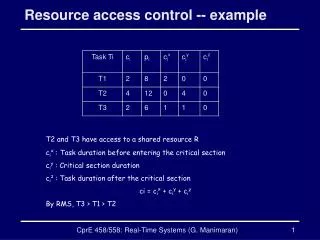
Resource access control -- example T2 and T3 have access to a shared resource R cix : Task duration before entering the critical section ciy : Critical section duration ciz : Task duration after the critical section ci = cix + ciy + ciz By RMS, T3 > T1 > T2 CprE 458/558: Real-Time Systems (G. Manimaran)
Schedules Locks R Preempted by T3 RMS Schedule Direct blocking of T3 by T2 Release R T3 T1 T2 T3 T2 T1 T2 T3 T3 T2 10 11 12 0 2 4 6 7 8 14 16 Priority inversion of T3 by T1 RMS Schedule with Priority Inheritance Protocol Direct blocking of T3 by T2 T3 T1 T2 T3 T2 T3 T1 T3 T2 0 Inheritance blocking of T1 by T2 CprE 458/558: Real-Time Systems (G. Manimaran)