Transcendentalism
130 likes | 240 Vues
Transcendentalism is a philosophical movement that emphasizes the ideal spiritual state surpassing the physical. Originating in the mid-1800s Boston and Concord, MA, it was influenced by Unitarian reform and the works of thinkers like Ralph Waldo Emerson and Henry David Thoreau. This movement sought to delve into the human connection with nature through emotion rather than reason. Not limited to religion, Transcendentalism explored literature, social reform, and American culture, advocating for environmental consciousness and civil disobedience.


Transcendentalism
E N D
Presentation Transcript
Transcendentalism Walden Pond, Concord MA
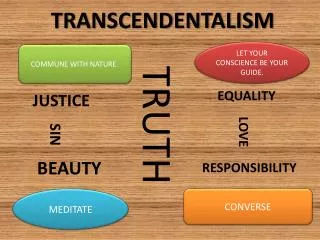
What does “transcendentalism” mean? • There is an ideal spiritual state which “transcends” the physical and empirical. • A loose collection of eclectic ideas about literature, philosophy, religion, social reform, and the general state of American culture. • Transcendentalism had different meanings for each person involved in the movement.
Where did it come from? • Ralph Waldo Emerson gave German philosopher Immanuel Kant credit for popularizing the term “transcendentalism.” • It began as a reform movement in the Unitarian church. • It is not a religion—more accurately, it is a philosophy or form of spirituality. • It centered around Boston and Concord, MA. in the mid-1800’s. • Emerson first expressed his philosophy of transcendentalism in his essay Nature.
What did Transcendentalists believe? Transcendentalism: A movement that sought to explore the relationship between humans and nature through emotions rather than through reason. This was not a religion, but rather a movement to show humans how connected they are to the nature around them.
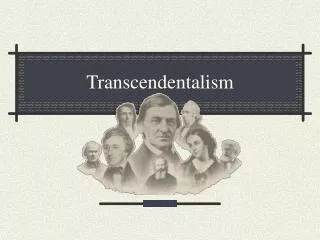
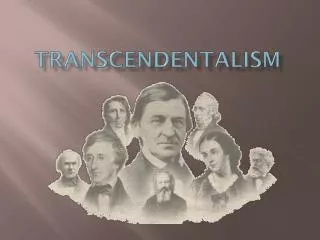
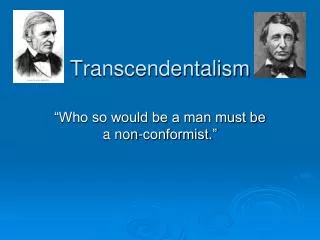
Who were the Transcendentalists? • Ralph Waldo Emerson • Henry David Thoreau
Ralph Waldo Emerson • 1803-1882 • Unitarian minister • Poet and essayist • Founded the Transcendental Club • Popular lecturer • Banned from Harvard for 40 years following his Divinity School address • Supporter of abolitionism
Henry David Thoreau • 1817-1862 • Schoolteacher, essayist, poet • Most famous for Walden and Civil Disobedience • Influenced environmental movement • Supporter of abolitionism
Literature • 1800’s literature illustrated daily life in early America. • Famous Authors of the 1800’s • Washington Irving wrote • Rip Van Winkle, the Legend of Sleepy Hollow and The Sketchbook • Theme - change occurs but traditions remain • James Fenimore Cooper wrote • The Deerslayer, The Last of the Mohicans • Theme – life on the frontier • Nathaniel Hawthorne wrote • The Scarlet Letter • Theme – morality, stigma’s, good v evil • Herman Melville wrote • Moby Dick • Theme – good v evil
Literature • Famous Authors of the 1800’s continued • Henry Wadsworth Longfellow wrote • Paul Revere’s Ride • Theme – American historical events • Ralph Waldo Emerson wrote • Concord Hymn • Theme – American historical event, spirituality and transcendentalism • Henry David Thoreau wrote • Resistance to Civil Government • Theme – civil disobedience, nature, abolitionism
Literature • Famous Authors of the 1800’s continued • Louisa May Alcott wrote • Little Women • Theme – Feminine humanity • William Cullen wrote • Thanatopsis • Theme – natural beauty, study of nature, understand life and death
art • Famous Artists of the 1800’s • Hudson River School • Theme – natural wonders, landscapes of the Catskills Mountains and the Hudson River. • Established by Thomas Doughty • Artists: Thomas Cole, Asher Durand and George Caleb Bingham • Artists: George Catlin and Alfred Jacob Miller • Theme – Native American life, fur traders, riverboat workers.
music • Famous Musicians of the 1800’s • Stephen C. Foster • Performed musicals with American songs in large cities and log cabins using banjos and pianos. • Combined African and European music to create a uniquely American sound. • Songs: My Old Kentucky Home and Swanee River
architecture • Architectural Themes of the 1800’s • Public buildings were modeled on classical styles of Rome and Greece. • Private homes and plantations were modeled on the style of Greek Revival .