The Power of Onomatopoeia in Writing: Captivating Sounds and Imagery
Onomatopoeia involves words that imitate natural sounds, creating vivid sensory experiences in writing. By using words like "POW," "ZAP," or "buzz," writers can engage readers' imaginations, making them feel present in the story. This literary device captures attention and enhances descriptions, allowing audiences to visualize and hear the action. Prominent examples can be found in literature, such as in “Bud, Not Buddy” by Christopher Paul Curtis, that masterfully employs onomatopoeic language to bring scenes to life.

The Power of Onomatopoeia in Writing: Captivating Sounds and Imagery
E N D
Presentation Transcript
Onomatopoeia Kelly Holleman
Onomatopoeia words that imitate sounds POW Ting! ZAP!
Onomatopoeia • “I had to get out of the house so I could get that buzzing feeling back and figure out what it meant.” 35 • Chicken Boy by Frances O’Roark Dowell Follett’s Titlewave.com
Onomatopoeia • “Herman E. Calloway stood there huffing and puffing like the Big Bad Wolf.” • Bud Not Buddy by Christopher Paul Curtis http://bloggers.com/post/whos-afraid-of-the-big-bad-wolf-2569409
Onomatopoeia • "I felt like something as big as a steam locomotive engine was chug-chug-chugging right past my ear." • Bud Not Buddy by Christopher Paul Curtis http://www.google.com/imgres?q=train%2Bclipart&hl=en&safe=strict&qscrl=1&nord=1&rlz=1T4ADRA_enUS429US431&noj=1&tbm=isch&tbnid=QDPA-yLF-QdaCM:&imgrefurl=http://etc.usf.edu/clipart/4000/4051/old-train_1.htm&docid=p1PwaNNqQcrEmM&imgurl=http://etc.usf.edu/clipart/4000/4051/old-train_1_lg.gif&w=700&h=572&ei=Uqt9T8KRIoWw8AShsLnbDA&zoom=1&iact=rc&dur=393&sig=107199652676881432607&page=1&tbnh=145&tbnw=177&start=0&ndsp=10&ved=1t:429,r:6,s:0,i:82&tx=76&ty=94&biw=1093&bih=514
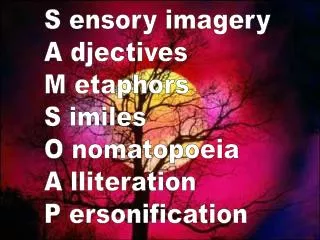
Onomatopoeia • Onomatopoeia is the imitation of natural sounds in word form. It is sensory language directed specifically at our sense of sound. It puts the audience right in the action. These words help us form mental pictures about the things, people, or places that are described. What's important about onomatopoeia is that these are words that sound like the thing that you're trying to do. So a word like pow, that's onomatopoeia. A word like quack, it doesn't have any definition other than it's trying to reproduce the sound that's made in nature. If you can use words like that, if you can invent words like that, you're on the road to great success with your writing. The audience feels like they're there. They can see it, they can hear it, it's all around them.