Download
1 / 15
150 likes | 268 Vues
In the late 1990s, Kevin Peterson aimed to improve diabetes management (DM) in primary care practices. His literature review identified nine effective modalities encapsulated in the TRANSLATE acronym. A successful randomized control trial involving over 8,000 diabetic patients informed a pragmatic clinical trial, refining the TRANSLATE framework to compare computer decision support with facilitated support. This innovative model emphasizes crucial aspects like administrative buy-in, local clinician champions, and a team approach to address common challenges in diabetes care effectively.

E N D
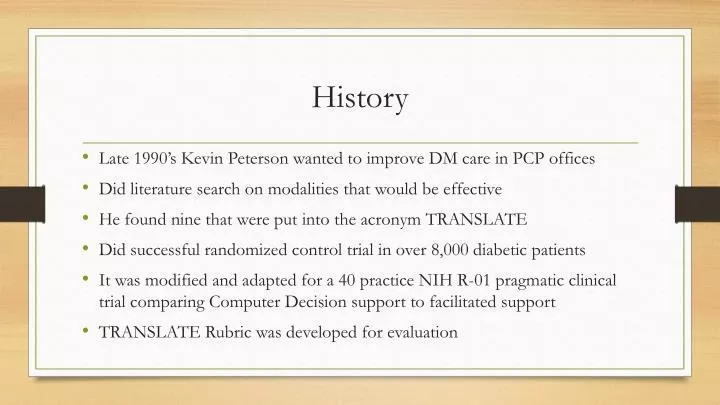
History • Late 1990’s Kevin Peterson wanted to improve DM care in PCP offices • Did literature search on modalities that would be effective • He found nine that were put into the acronym TRANSLATE • Did successful randomized control trial in over 8,000 diabetic patients • It was modified and adapted for a 40 practice NIH R-01 pragmatic clinical trial comparing Computer Decision support to facilitated support • TRANSLATE Rubric was developed for evaluation
TRANSLATE • Target • Reminder • Administrative Buy-In • Network Information System • Site Coordinator • Local Clinician Champion • Audit and Feedback • Team Approach • Education
Target • Goal setting • Needs to be • Clear Measurable and feasible • Common office problems • No targets • Trying to do too many things at once
Reminder • Actionable information at the point of care
Administrative Buy-in • Commitment of Resources • Money • Personnel
Networked Information Systems • Population Heatlh • Registries • Prefereably easily created
Site Coordinator • Local accountability • Usually a nurse or office manager • Single point of contact for the PF • Arrangement of team meetings • Arrangement of education for the staff • Responsible for appropriate data collection
Local Clinician Champion • For Clinician buy-in • Explanation of Evidence Base • Does not have to be MD (but usually is) • NPs and PAs have done a good job with this • Large regional variation • Some only accept MD
Audit and Feedback • Longitudinal Reports • How the practice is progressing over time • Benchmarking Reports • How the practice is doing compared to others
Team Approach • Regular meetings • Broad input on workflow and process plans • Allowing people to work to the top of their license • Huddles (brief micro-team meetings) have also shown success
Education • Training in all its forms: • Academic Detailing* • Collaborative Learning Groups}* • In-service • CME etc * Most commonly used in practice transformation
Preliminary Results Total Score