The Acropolis of Athens: Cultural Significance and Archaeological Insights from the Classical Era
This lecture delves into the rich historical and cultural landscape of Athens during the 5th and 4th centuries BCE, a pivotal era marked by the Persian Wars and the Peloponnesian War. Focusing on the Acropolis as the central cult site, we explore its architectural elements, including the Parthenon and its sculptures, through archaeological evidence and ancient literary sources. We also discuss the impacts of prominent leaders like Perikles and the significance of events such as the Panathenaic festival procession, providing insights into why this period is deemed ‘classical.’

The Acropolis of Athens: Cultural Significance and Archaeological Insights from the Classical Era
E N D
Presentation Transcript
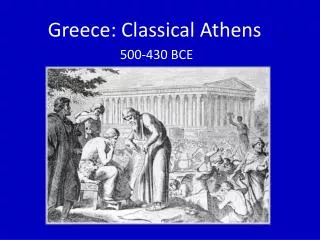
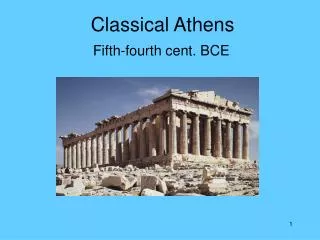
Classical Athens Fifth-fourth cent. BCE
Lecture Layout Athens in Vth century BCE Archaeological evidence: the Acropolis (central cult place, cfr. last week lectures) Why ‘classical’? Athens and us
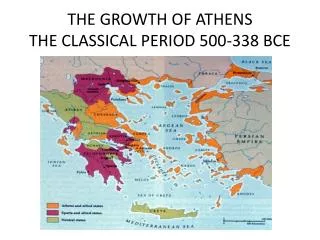
Some dates (cfr. Gates, ) • Persian wars (499-479 BCE) 499-494 rebellion of Greek cities led by Miletus in Asia Minor (modern Turkey) against Persia. The rebellion was suppressed. 490 Darius attacks Greece. Battle of Marathon, Athens victory 480-479 Xerxes invades Greece, sack of Athens 480 Battle of Thermopylae and Salamis 479 Battles of Plataea and Mycale (naval battle): Persians defeated 461-429 under leadership of perikles, Athens took control of the Delian League and start rebuilding the Acropolis • Peloponnesian war (431-404 BCE)
The Parthenon and the British Museum: you must study the webpages on Parthenon (here’s link, see also link on course website)
The sculptures • The metopes: combats • The frieze: Panathenaic festival procession • The pediments: episodes of Athena’s life • Cult statue
The Parthenon Reconstruction of Parthenon sculptures: • Archaeological evidence • Ancient literary sources (as Pausanias, or Plutarch) • Sketches of modern artists, as Jacques Carrey (1674)
Metopes(mythological combats) • South side battle between Lapiths and Centaurs, GR South Metope XXVII
Offerings found in the tombs surrounding the Herooon. Centaur figurine, terracotta, geometric
The Frieze • On the external wall of the cella (naos), pronaos and opisthodomos Interpreted as a representation of the Panathenaic procession PARTHENON FRIEZE RECONSTRUCTION: http://www.mcah.columbia.edu/parthenon/flash/main.htm
Varvakeion Athena, copy of Phidias statue of Athena Parthenos, II cent. CE (Athens National Museum)
Athena Parthenos, Historical Reproduction (Nashville, Tennesse)