Download
1 / 5
60 likes | 190 Vues
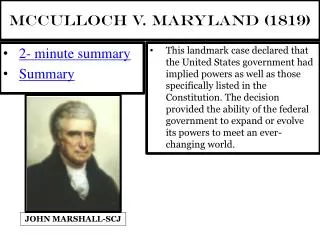
In the landmark case of McCulloch v. Maryland, the Supreme Court addressed the constitutionality of the Second Bank of the United States. When Maryland attempted to undermine the bank by imposing a tax on its notes, Chief Justice John Marshall asserted the bank's constitutional status through the interpretation of implied powers under the Constitution. This ruling reinforced federal authority, affirmed that "the power to tax involves the power to destroy," and endorsed a "loose construction" of the Constitution, ultimately strengthening the federal government's powers at the expense of states.

E N D
Text from Document • “There is nothing in the Constitution of the United States similar to the Articles of Confederation, which exclude incidental or implied powers.”
Main Idea • Maryland attempted to destroy a branch of the Bank of the U.S by imposing a tax on its notes. • John Marshall declared bank constitutional by invoking the Hamiltonian doctrine of implied powers.
Inferences • Strengthened federal authority • Affirmed “that the power to tax involves the power to destroy” and “that a power to create implies a power to preserve.” • Supported “loose construction” of constitution.
Point of View of Bias • John Marshall was famous for a group of his decisions involving strengthening the power of the federal government at the expense of the states.