Solid Coloring of Objects Built from 3D Bricks
150 likes | 228 Vues
Explore the intriguing concept of solid coloring complex objects constructed from 3D bricks, from 2D to 3D colorability theorems and practical applications.


Solid Coloring of Objects Built from 3D Bricks
E N D
Presentation Transcript
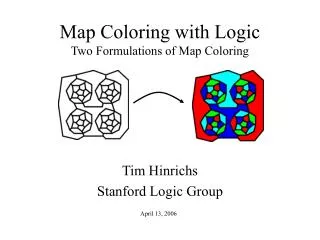
Solid-coloring of objects built from 3D bricksJoseph O’Rourke “solid-coloring” “object” “brick” … all will be explained later
Coloring 2D Maps Famous 4-Color Theorem: Every map can be colored with at most 4 colors so that any two regions that share a positive-length boundary receive a different color: maps may be “4-colored.” A much less famous 3-Color Theorem: Every map all of whose regions are triangles may be 3-colored. A theorem of Sibley & Wagon: Every map all of whose regions are parallelograms may be 3-colored.
Complex of triangles/parallelograms Best to view these “maps” as complexes constructed by gluing triangles/parallelograms whole edge-to-whole edge. In triangle complex, dual graph has maximum degree 3. [See next slide] In parallelogram complex, dual graph has maximum degree 4.
Triangle Complex Dual graph has maximum degree 3
Triangle Complex: 3-colorable Sketch of proof: Find a triangle with vertex v on the “boundary” of the complex. There must be at least one triangle t with an “exposed” edge e. Remove t, 3-color remainder by induction, put back. Color t with the color not used on its at most two neighbors.
2D regions Triangle complex: 3-colorable. Parallelogram complex: 3-colorable. Convex-quadrilateral complex? 4 colors needed
2D vs. 3D 2D coloring well-explored 3D “solid coloring”: largely unexplored
Solid-coloring 3D “bricks” Complex built from gluing bricks of various shape types whole face-to-whole face. Color each brick so that no two that share a face have the same color. Theorems: (JOR) Objects built from tetrahedra may be 4-colored. (JOR) Objects built from d-simplices in Rd may be (d+1)-colored. Suzanne Gallagher (Smith 2003): Genus-0 (no-hole) objects (i.e., balls) built from rectangular bricks may be 2-colored(!).
Figure in proof for tetrahedra Identifying some tetrahedron with an exposed face.
Figure in proof of 2-colorability (One “layer” of perhaps many)
The Unknown Is every object built from rectangular bricks 3-colorable? Suzanne & JOR proved this for 1-hole objects. Is every object built from parallelepipeds 4-colorable? Is every zonohedron (which are all built from parallelepipeds) 4-colorable? How many colors are needed for objects built from convex hexahedra? Etc.
Four parallelepiped bricks,needs 4 colors Dual graph is K4 Rhombic dodecahedron
A zonohedon: 4060 bricks How many colors needed?