
OSPF (Open Shortest Path First)
110 likes | 340 Vues
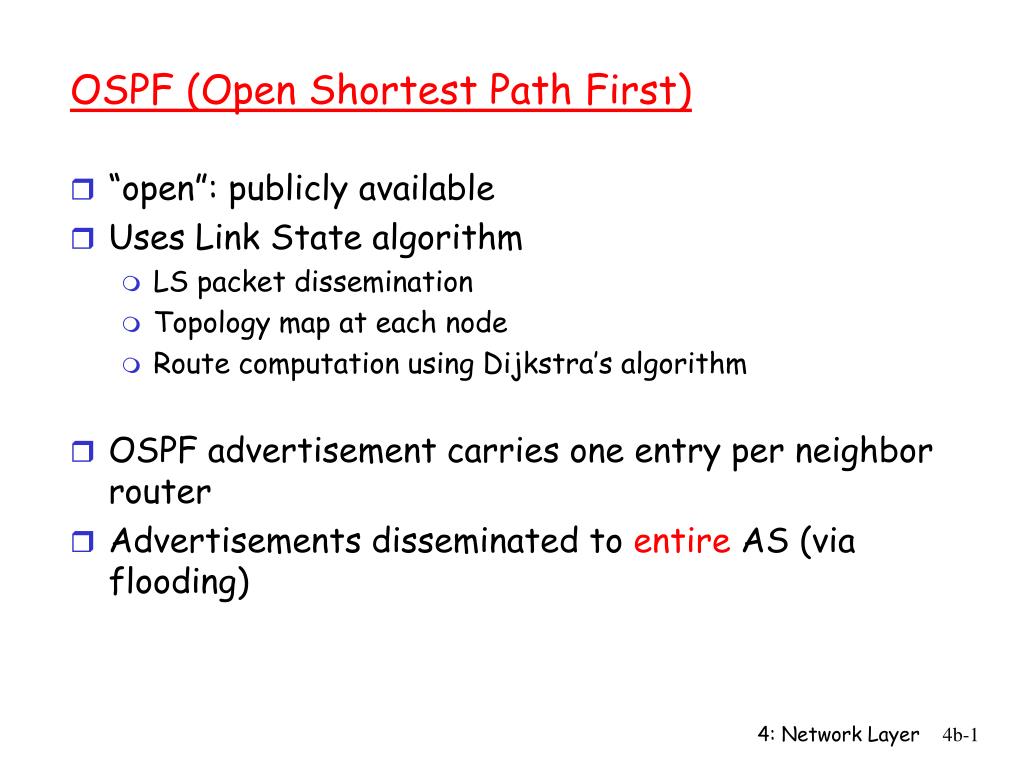
OSPF (Open Shortest Path First). “open”: publicly available Uses Link State algorithm LS packet dissemination Topology map at each node Route computation using Dijkstra’s algorithm OSPF advertisement carries one entry per neighbor router
OSPF (Open Shortest Path First)
E N D
Presentation Transcript
OSPF (Open Shortest Path First) • “open”: publicly available • Uses Link State algorithm • LS packet dissemination • Topology map at each node • Route computation using Dijkstra’s algorithm • OSPF advertisement carries one entry per neighbor router • Advertisements disseminated to entire AS (via flooding) 4: Network Layer
OSPF “advanced” features (not in RIP) • Security: all OSPF messages authenticated (to prevent malicious intrusion); TCP connections used • Multiple same-cost paths allowed (only one path in RIP) • For each link, multiple cost metrics for different TOS (eg, satellite link cost set “low” for best effort; high for real time) • Integrated uni- and multicast support: • Multicast OSPF (MOSPF) uses same topology data base as OSPF • Hierarchical OSPF in large domains. 4: Network Layer
Hierarchical OSPF 4: Network Layer
Hierarchical OSPF • Two-level hierarchy: local area, backbone. • Link-state advertisements only in area • each nodes has detailed area topology; only know direction (shortest path) to nets in other areas. • Area border routers:“summarize” distances to nets in own area, advertise to other Area Border routers. • Backbone routers: run OSPF routing limited to backbone. • Boundary routers: connect to other ASs. 4: Network Layer
IGRP (Interior Gateway Routing Protocol) • CISCO proprietary; successor of RIP (mid 80s) • Distance Vector, like RIP • several cost metrics (delay, bandwidth, reliability, load etc) • uses TCP to exchange routing updates • Loop-free routing via Distributed Updating Alg. (DUAL) based on diffused computation 4: Network Layer
Inter-AS routing 4: Network Layer
Internet inter-AS routing: BGP • BGP (Border Gateway Protocol):the de facto standard • Path Vector protocol: • similar to Distance Vector protocol • each Border Gateway broadcast to neighbors (peers) entire path (I.e, sequence of ASs) to destination • E.g., Gateway X may send its path to dest. Z: Path (X,Z) = X,Y1,Y2,Y3,…,Z 4: Network Layer
Internet inter-AS routing: BGP Suppose: gateway X send its path to peer gateway W • W may or may not select path offered by X • cost, policy (don’t route via competitors AS), loop prevention reasons. • If W selects path advertised by X, then: Path (W,Z) = w, Path (X,Z) • Note: X can control incoming traffic by controling it route advertisements to peers: • e.g., don’t want to route traffic to Z -> don’t advertise any routes to Z 4: Network Layer
Internet inter-AS routing: BGP • BGP messages exchanged using TCP. • BGP messages: • OPEN: opens TCP connection to peer and authenticates sender • UPDATE: advertises new path (or withdraws old) • KEEPALIVE keeps connection alive in absence of UPDATES; also ACKs OPEN request • NOTIFICATION: reports errors in previous msg; also used to close connection 4: Network Layer
Why different Intra- and Inter-AS routing ? Policy: • Inter-AS: admin wants control over how its traffic routed, who routes through its net. • Intra-AS: single admin, so no policy decisions needed Scale: • hierarchical routing saves table size, reduced update traffic Performance: • Intra-AS: can focus on performance • Inter-AS: policy may dominate over performance 4: Network Layer