Download
1 / 15
150 likes | 260 Vues
Explore the journey of the Security Development Lifecycle (SDL) through its historical phases in this insightful presentation by Mike Craigue. With over two decades of experience in information security and a background in web and database application development, Craigue outlines key challenges and advancements in SDL. Discover how the industry has evolved, the role of compliance and training, and future directions influenced by cloud and mobile technologies. Gain valuable lessons learned from a team of seasoned security consultants dedicated to enhancing software security.

E N D
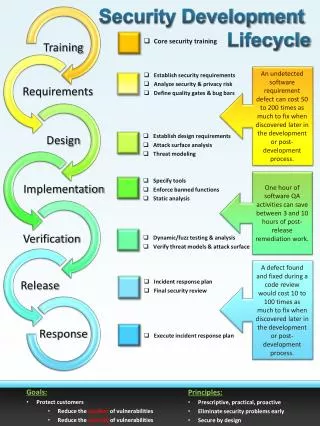
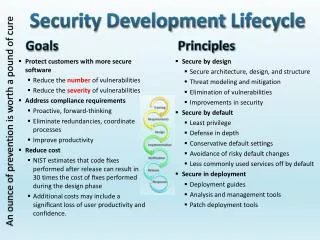
Security Development Lifecycle: A History in 3 Acts Mike Craigue October 7, 2011
Speaker Bio • Joined Dell in 1999 • Director of 14-member Security Consulting team, serving • IT • Product Group • Services • Prior to joining Dell’s information security team, spent over a decade building Web and database applications • CISSP and CSSLP from ISC2 • Taught Database Management and Business Intelligence/Knowledge Management at St. Edward’s University in their MBA and MS CIS programs • PhD from the University of Texas at Austin in Higher Education Administration and Finance 2
The Cast Heroes: 25 consultants over the past 4 years • 14 today, engaged on 500+ active projects • 2 PhD’s (one in information security!) • Multiple MA’s, 2 MBA’s in progress • CISSP’s, CSSLP’s, CEH’s • 10+ years professional experience typical; one team member has 17 years at the company • 5 have transferred internally • 6 have taken positions at MS, IBM, G-S, etc. 3
The Cast (continued) Heroes: 3 local celebrities in web application security • Gustavo Barbato – Cloud Security R&D, Technical Architecture Global Standards, GSERB • Mauricio Pegoraro– CISSP training leader, 3rd party script/tag and cookie governance • Rafael Dreher– Software Development Lifecycle Process Review Board, Source Code Analysis expert 4
The Cast (continued) Villains (you already know this list): • Nation-states • Collectives • Malicious insiders • Careless insiders • Script kiddies • Tight budgets • Re-orgs 5
The Past 6
The Past Modest beginnings, focused on SCA • 300 projects in our initial year • Spreadsheets for risk calculation converted into a home-grown application • eComm developer adoption was key • PCI, SOX compliance were important drivers • MS made key contributions (SDL, Threat Modeling) 7
The Present Holistic consulting (app, db, network, host) • Engaging with over 80% of projects (1,000 this year, 500+ currently active) • OpenSAMM Scoring of our SDL • Flexible approach to Traditional vs. Agile methods • Keeping our training curriculum fresh is a challenge • Finding and retaining team members is a challenge • The identity of the company is transforming • Cloud and mobile are forcing us to adapt • Customer satisfaction surveys help us measure quality 9
The Present (continued) • Java, C#.NET are the most typical languages used • Visual Studio 2010, Eclipse are the most common IDE’s • MS Anti-XSS library, Web Protection Library, OWASP ESAPI are part of our FAQ’s • 3RD Party script & pixel tag reviews/due diligence • SDL • GSRM risk ranking • Source Code Analysis • Threat Modeling • Ethical Hacking • IPSA (legal) 10
The Future 11
The Future • Linking OpenSAMM strategy to overall security strategy • Increased use of threat modeling • Phase exit reviews • Expanding skill sets in mobile security, cloud security • Metrics that balance quantity and quality of engagements • Product Group, Services initiatives related to M&A 12
Lessons Learned • Build consensus among developers first; appeal to their love of writing high-quality software • Take early success stories to executives • Communicate to executives in terms of risk • Create a variety of awareness and education programs • Face-to-face seminars, celebrities welcome • General courseware, manager courseware, 30-minute refresher courses • We’re doing fundamentals, not cutting-edge security work • Existing SDLC; risk modeling tool was key touchpoint • Partnered with other groups 13
Lessons Learned (continued) • Added ourselves into an existing SDLC; risk modeling tool was key touchpoint • Partnered with other groups • Developers—key allies • Legal—contract templates, muscle • Enterprise Architecture—tools, technology standardization; SOA • Privacy—global background / EU representation • Compliance—policies/standards • Leveraged regulatory compliance for adoption • Global staff, time zone / business segment alignment initially • Acquisition challenges • Threat modeling is time-consuming; use sparingly • One step at a time, one org at a time, show metrics, build momentum • Developer desktop standardization is ideal, but hard to attain • Exception management process, executive escalation, roadmaps 14
Q&A, Acknowledgements, Thank you! • Thanks to: • Gustavo Barbato • Rafael Dreher • Mauricio Pegoraro • Tim Youngblood • Michael Howard • Contact: • michael_craigue dell.com 15