Understanding Linear Equations and Inequalities in One Variable
70 likes | 213 Vues
This text explores the fundamentals of linear equations and inequalities in one variable. A linear equation has one unknown variable expressed in the form ax + b = 0, where a and b are real numbers. Meanwhile, linear inequalities can be represented as ax + b > c, ax + b < c, and others. Additionally, concepts of intervals, including closed, open, and half-open, are defined where [a, b] includes endpoints, and (a, b) excludes them. The properties of addition, subtraction, multiplication, and division concerning inequalities are also discussed, providing a foundational understanding of these essential algebraic concepts.


Understanding Linear Equations and Inequalities in One Variable
E N D
Presentation Transcript
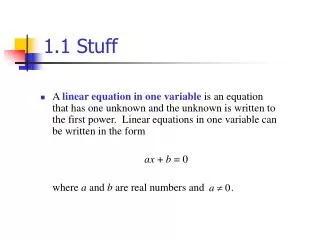
1.1 Stuff • A linear equation in one variable is an equation that has one unknown and the unknown is written to the first power. Linear equations in one variable can be written in the form ax + b = 0 where a and b are real numbers and .
1.4 Stuff • A linear inequality in one variable is an inequality that can be written in one of the following forms ax + b > c ax + b < c ax + b c ax + b c where a, b, and c are real numbers and a ≠ 0.
1.4 Stuff • Let a and b represent two real numbers with a < b. • A closed interval, denoted by [a, b], consists of all real numbers x for which . • An open interval, denoted by (a, b), consists of all real numbers x for which a < x < b. • Thehalf-open, orhalf-closed, intervals, are (a, b], consisting of all real numbers x for which and [a, b) consisting of all real numbers x for which In each of these definitions, a is called the left endpoint and b the right endpoint.
1.4 Stuff • Addition (and Subtraction) If a < b, then a + c < b + c. Similar properties exist for >, , and .
1.4 Stuff • Multiplication (and Division) If c > 0 and a < b, then ac < bc. If c < 0 and a < b, then ac>bc. Similar properties exist for >, , and .