
When are Frames Forwarded?
E N D
Presentation Transcript
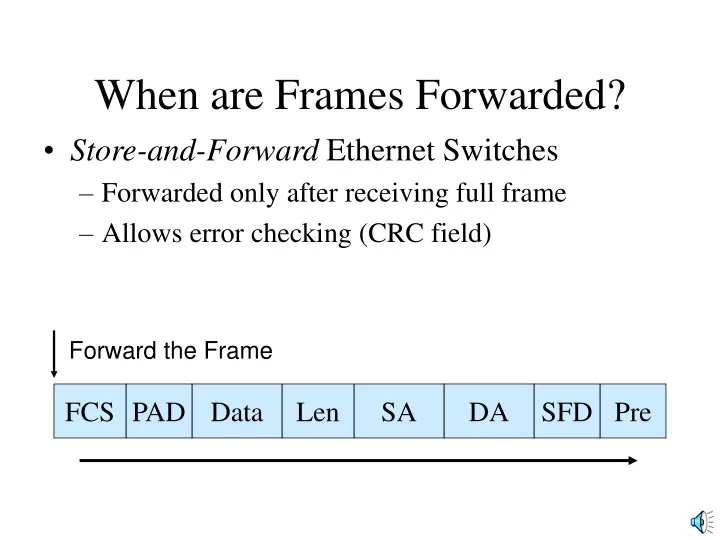
When are Frames Forwarded? • Store-and-Forward Ethernet Switches • Forwarded only after receiving full frame • Allows error checking (CRC field) Forward the Frame FCS PAD Data Len SA DA SFD Pre
When are Frames Forwarded? • Cut-Through Ethernet Switches • Forward after seeing only part of a frame • Minimum is destination address to determine output port • May need to see tag fields for priority, VLAN • May wait until 46 octets of data plus PAD • Faster operation than store-and-forward Forward the Frame FCS PAD Data Len SA DA SFD Pre
When are Frames Forwarded? • Hybrid Ethernet Switches • Operate mostly in cut-through mode • Do check for errors sometimes • If too many errors, go to store-and-forward mode
Bad Switch Organization • One Server for All Clients • All traffic goes to and from server • Bottlenecks: no simultaneous conversations • No major benefits compared to hub Bottleneck Ethernet Switch
Bad Switch Organization • Multiple Servers for Clients • Allows simultaneous conversations • Brings switching’s main benefit Ethernet Switch
Congestion, Latency, and Remedies Peak Loads Congestion and Latency Overprovisioning Capacity Priority Quality of Service Traffic Shaping
The Peak Load Problem • Capacity Sufficient Most of the Time • Otherwise, get bigger switches and trunk lines! • BriefTraffic Peaks can Exceed Capacity • Frames will be delayed in queues or even lost if queue gets full Traffic Peak Capacity
Overprovisioning • Overprovisioning: Install More Capacity than Will be Needed Nearly All of the Time • Wasteful of capacity • Still, usually the cheapest solution today because of its simplicity Overprovisioned Capacity Traffic Peak
Priority • Assign Priorities to Frames • High priority for time-sensitive applications (voice) • Low priority for time-insensitive applications (e-mail) • In traffic peaks, high-priority frames still get through • Low-priority applications do not care about a brief delay for their frames Low-Priority Frame Waits Briefly High-Priority Frame Goes
Priority • Standardizing Priority • 802 Tag Fields are standardizing priority for Ethernet and other 802 LAN technologies • Priority is also being standardized by the IETF for IPv4 and IPv6 (Diffserv for differentiated services) • 802 and IETF are harmonizing efforts for end-to-end priority Low-Priority Frame Waits Briefly High-Priority Frame Goes
Priority • Once Widely Available, Priority Should Replace Overprovisioned Capacity as the Least Expensive Solution to Peak Load Problems Low-Priority Frame Waits Briefly High-Priority Frame Goes
Full Quality of Service (QoS) • Priority Makes no Quantitative Promises of Maximum Latency, etc. • Quality of Service (QoS) Makes Quantitative Promises for such things • Different Frames may have Different QoS Guarantees; Some may have no guarantee High Guarantee Low or No Guarantee
Full QoS is Expensive • For high guarantees, capacity must be reserved at each switch and trunk line along the way • Capacity is wasted if not used • Like circuit switching but at data link layer • (Circuit switching is at physical layer) High Guarantee Reserved Capacity Low or No Guarantee
Full QoS is Not a Cure-All • Traffic with no guarantees will not benefit • It may not get through at all • Often, voice traffic is given strong guarantees while data traffic is given low or no guarantees High Guarantee Reserved Capacity Low or No Guarantee
Traffic Shaping • Overprovisioning, Priority, and QoS are Ways to Cope with Brief Congestion • Traffic ShapingPrevents recognizes that congestion is beginning, acts to stop it • Switch Tells Some Sources to Slow or Stop if Congestion is Beginning Slow or Stop Source A Network Continue Source B
Traffic Shaping • Called Shaping Because Governs the “Shape” of the Traffic • Mix of traffic of various kinds is governed by policies about traffic Slow or Stop Source A Network Continue Source B