The Baroque Era: Exploring the Musical Legacy of Bach, Handel, and Vivaldi
480 likes | 606 Vues
Dive into the rich tapestry of the Baroque period, focusing on the pivotal works of Johann Sebastian Bach, George Frideric Handel, and Antonio Vivaldi. This exploration reveals how music evolved amidst the socio-political changes of the 17th and 18th centuries, characterized by complexity and grandeur. Discover the innovative techniques pioneered by these composers, including contrapuntal writing and the rise of the virtuoso musician. Experience the fusion of sacred and secular music, and learn about the cultural transformations that shaped Baroque artistry.


The Baroque Era: Exploring the Musical Legacy of Bach, Handel, and Vivaldi
E N D
Presentation Transcript
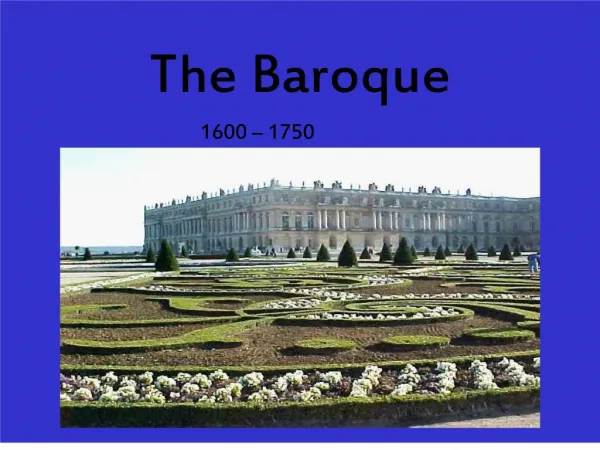
The Baroque • Text book 108-143 • Musical tracks 9-13
Class 2-4 • Class #2: Johann Sebastian Bach • Class #3: George Fredrich Handel • Class #4: Antonio Vivaldi, etc.
Class #2 Johann Sebastian Bach and the Baroque
400 500 600 700 800 900 1000 1100 1200 1300 1400 1500 1600 1700 1800 1900 Culture • Turbulent change in politics, science, arts • Religious wars • Exploration of the New World • Rise of middle-class culture • Music making centered in the home, church, and universities • Collegium musicum
What is “Baroque”? • Intense; • Complex; • Dense; • Opulent; • Extravagant.
Main musical ideas from Baroque: • Contrapuntal • Grandeur • Complexity • Virtuosity
Johann Sebastian Bach (1685–1750) • German Composer, Organist, Educator • Culminating figure of the Baroque style • Career in Northern Germany • Musical family • Organist and composer • Devout Lutheran • Secular and church patrons during career
Personality • 20 children! • Only five major appointments. • Musical goals and objectives? • Work ethic.
JS Bach Society Web Sites • http://www.jsbach.org/ • http://www.baroquemusic.org/bqxjsbach.html
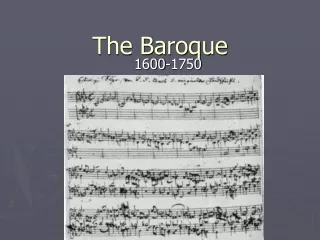
Contrapuntal • Little Fugue in G minor • Mühlausen • 31 years old • Pietist
The Fugue and Its Devices • Fuga • Contrapuntal, based on imitation • Subject unifies the work • Choral or instrumental • Melodic lines are referred to as voices
Contrapuntal devices • Text book 139 • Inversion • Retrograde • Augmentation • Diminution • Combinations
Work week • Monday • Tuesday • Wednesday • Thursday • Friday • Saturday • Sunday
Jail! • Kapellmeister in Weimar
Well-Tempered Clavier • Intended as only instructional pieces; • Dedication • “for the use and profit of young musicians”
The Well-Tempered Clavier, 1 & 2 • New technique! • Equal temperament = tuning • Two pieces each in every new 24 Major and Minor keys • 24 X 2 = 48 per book • Glenn Gould
Improvisation • Improvisation • First “stars” • Competition. • William Goldstein master class
Baroque Musical Rhythm • Baroque rhythm • Dance
The Rise of the Virtuoso Musician • Technical improvements in instrument making • Composers challenging the performers
The Rise of Virtuosity • Vocal • Castrato • Farinelli
The Doctrine of the Affections • Union of text and music • One mood, or affection, per movement or piece
Women in Baroque Music More professional women were singers and instrumentalists • Francesca Caccini • Barbara Strozzi • Faustina Bordoni • Francesca Cuzzoni • Elisabeth-Claude Jacquet de la Guerre
Bach and the Sacred Cantata • Sacred cantatas • Secular cantatas • Sacred cantatas for the Lutheran church • Multimovement works
The Lutheran Chorale • Chorale • Battle hymns of the Reformation • Early hymns: in unison • Later hymns: 4-part harmony, soprano melody • Unifying thread of the Protestant cantatas
Typical Sunday Services • 7 AM • Motet, hymns, organ solo. • 8 AM • Cantata and/or Chorale • 9 AM • Sermon, at least one hour • 10 AM – 12 Noon • Cantata and/or Chorale, Communion
Weekday Services • Daily Church • 6 AM • Hospitals • Jails • Funerals • Special events
Additional Duties • Church • Teaching • 9 AM – Noon • Latin, singing, composition • University collegiummusicum!
Sacred Vocal Music • Over 200 church cantatas • Four Passions • One Catholic Mass
Bach’s Cantatas • Typically have 5–8 movements • Many movements based on chorale tune • Several choral numbers • Solos recitatives arias
Bach: Chorale prelude on A Mighty Fortress Is Our God • Composed 140-plus organ chorales • Organ with three keyboards and a pedal keyboard • Based on chorale tune Ein feste Burg ist unser Gott • Varied texture
Performance • Ein Feste Burg A mighty fortress is our God, a bulwark never failing;Our helper He, amid the flood of mortal ills prevailing:For still our ancient foe doth seek to work us woe;His craft and power are great, and, armed with cruel hate,On earth is not his equal.
J. S. Bach and the Late Baroque Concerto • Cöthen period (1717–23) • Instrumental chamber works • Margrave Christian of Brandenburg
But first…. • Why was Bach in Berlin?
Brandenburg Concertos 1721, BWV 1046–1051 Three movements each: • I: Allegro, • ritornello form, contrapuntal • II: Andante, • Slower, quieter, continuous imitation • III: Allegroassai, • four-voiced fugue
Brandenburg Concerto #1 • 1st Movement • 2nd Movement • 3rd Movement
Concerto? Ritornello? • Where did those terms come from?
The Baroque Suite Suite: each movement is A-A-B-B • Allemande • Courante • Sarabande • Gigue (jig) • Other optional dances: minuet, gavotte, bourrée, passepied • Repeated sections ornamented second time
Cello Suite #1 • Yo-Yo Ma playing the Prelude (MTV-ish) • Yo-Yo Ma playing the Sarabande
The Goldberg Variations, 1741, BWV 988 • 30 variations • Harpsichord • Count Kaiserling • Johann Gottlieb Goldberg You know how I feel about Wikipedia, but….
Contrapuntal Master • Musical Offering (1747) • 'Gentlemen, old Bach is here'. • The Art of Fugue
Contrapuntal devices • Augmentation: longer time values • Diminution: shorter time values • Retrograde: backwards (starting from the last and going to the first) • Inversion: turning the melodic intervals upside down • Retrograde inversion: original melody is played upside down and backwards
Contrapunctus I, from The Art of Fugue • 4-voice fugue • Exposition: • Subject is presented in order: alto-soprano-bass-tenor • Episode: • Subject appears partially, in stretto • Incorporates musical symbolism • His name in notes Bb-A-C-H