Strong relation between max updraft speed and total flash rate at model
30 likes | 145 Vues
This study explores the assimilation of lightning data into the WRF model using 1-D and 4-D VAR techniques. The relationship between maximum updraft speed and total flash rate at 1 km resolution is examined, emphasizing the importance of incorporating CAPE and temperature profiles. Our methodology, currently under development, aims to adjust temperature profiles to enhance model accuracy. We will test our assimilation schemes on various storm cases, including nor’easters and hurricanes, and employ multiple lightning data sources to improve detection efficiency.


Strong relation between max updraft speed and total flash rate at model
E N D
Presentation Transcript
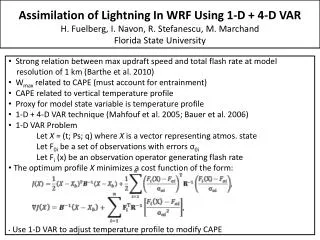
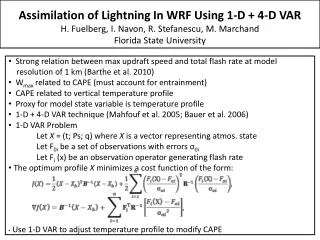
Assimilation of Lightning In WRF Using 1-D + 4-D VARH. Fuelberg, I. Navon, R. Stefanescu, M. MarchandFlorida State University Strong relation between max updraft speed and total flash rate at model resolution of 1 km (Barthe et al. 2010) Wmax related to CAPE (must account for entrainment) CAPE related to vertical temperature profile Proxy for model state variable is temperature profile 1-D + 4-D VAR technique (Mahfouf et al. 2005; Bauer et al. 2006) 1-D VAR Problem Let X= (t; Ps; q) where X is a vector representing atmos. state Let F0i be a set of observations with errors σ0i Let Fi(x) be an observation operator generating flash rate The optimum profile X minimizes a cost function of the form: Use 1-D VAR to adjust temperature profile to modify CAPE
The 1-D VAR temp. profiles considered new observations and then are assimilated using 4-D VAR • Our scheme currently is being coded • Will be completed in ≈ 2 months • Also will consider 3-D VAR and 4-D VAR without 1-D VAR • Our schemes and two nudging schemes will be tested on four cases with copious lightning • Nor’easter (tentatively the 10-11 Feb. 2010 storm) • North Pacific mid-latitude cyclone (17-19 Dec. 2009 storm) • Tropical cyclone (Hurricane Karl, 2010) • Severe thunderstorm/tornado outbreak in U. S. • Currently coding the schemes of Fierro et al. and Pessi and Businger
Preparing Fierro et al. Scheme • WRF Model Specifications • 6 km parent domain, 2 km nested domain, 60 vertical levels • No cumulus parameterization • WRF Single Moment 6-Class scheme • WWLLN lightning data assimilated at 10 min intervals over a 6 h period. Poor detection efficiency—only detects strongest flashes. Plan to use GLD360 data in the future • Fierro et al. used WTLN total lightning observations. • When WWLLN lightning was observed in a grid cell, we saturated the mixed phase region. • Fierro et al. supersaturated the region up to 5%, depending on the flash rate • Come see early results at our poster