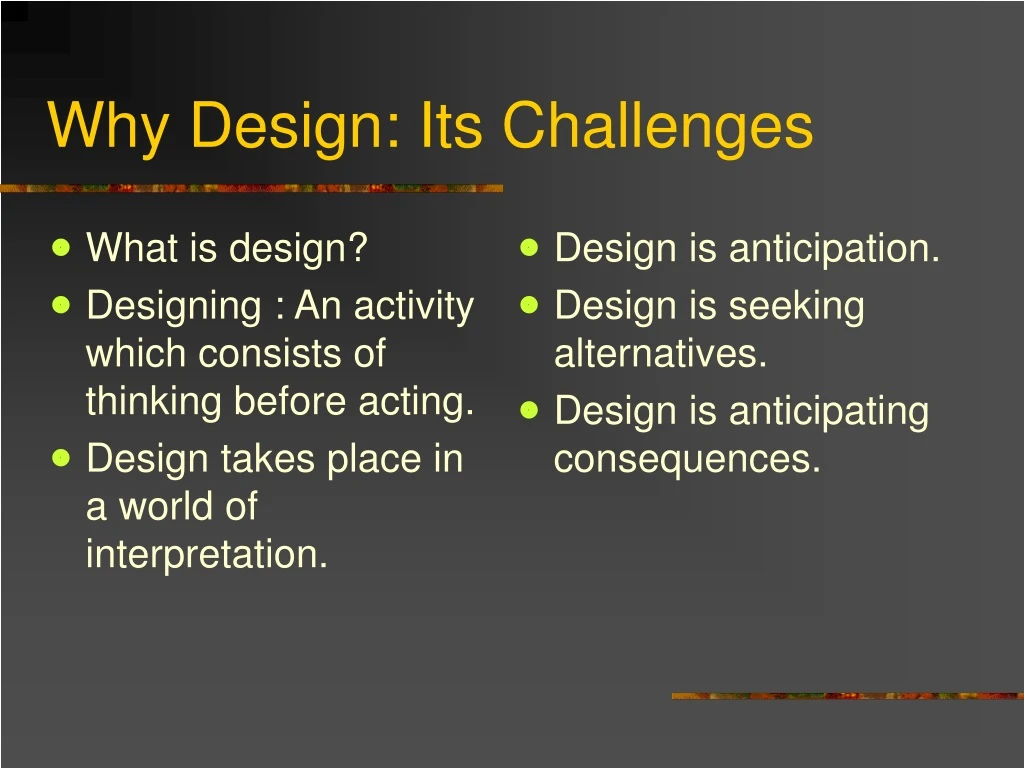

Why Design: Its Challenges
E N D
Presentation Transcript
What is design? Designing : An activity which consists of thinking before acting. Design takes place in a world of interpretation. Design is anticipation. Design is seeking alternatives. Design is anticipating consequences. Why Design: Its Challenges
Self Images of Designers • Designer as Artist a. Is the producer of fine art. b. “Space” is the medium of expression c. Values are based on self expression.
Designer as Builder • Knows how to deal with everyday problems • codes, budgets, schedules, materials • Strong practical and technical interests. • Are the designers who get things made/built.
Designer as Coordinator • Manages a group of specialist. • Complex is the favorite word. • Know a little about a lot. • Choreographs the high powered, narrow view of specialist.
Designer as Entrepreneur • Design as commodity. • Quality based on market. • Speculative action
Designer as Healer • Good environments make healthy people. • See the environment as a social illness. • Social problems solved by better buildings/places.
Designer as Planner • Design buildings like one would design an airplane. • FFF-Form follows function. • Making is a technical problem solving activity. • Buildings should be programmed by their function.
A Definition of Design Designing is an activity, aiming at the production of plans, which if executed are expected to lead to a situation with desired properties, and without undesired, unforeseen side or after effects. • Design as activity, not a product. • Aims at something– is purposeful. • Plan as a set of instruction.
Styles of Design Style 1: Routine Behavior Challenge Resolution
Style 2: Trial and Error Challenge Partial Resolution Resolution Yes No Feedback Test
Style 3: Criteria for Judgment New challenge Resolution Challenge Alternatives Feedback
The Knowledge of the Designer • Factual Knowledge – knowledge of how the world is. • Deontic Knowledge – knowledge of what ought to be. • Explanatory Knowledge – knowledge of why something is. • Instrumental Knowledge – how to knowledge. • Conceptural Knowledge – symbols and conventions.
Nature of Design Problems Two Types of Problems/Challenges • Tame Challenges • 1. Have an exhaustive definition • 2. Ends and Goals well defined • 3. Examples: puzzles, math equations, models • b. Wicked Challenges • 1. No exhauxtive definition • 2. Formulation same as resolution • 3. Examples: social, political, design, and planning
Design Challenge Characteristics • Wicked challenges have no exhaustive formulation. • The formulation is identical to the resolution. • Every wicked challenges can be considered a symptom of another wicked challenge. • Wicked challenges have no stopping rules. • Wicked challenges have many explanations for discrepancies.
Characteristics continued • Wicked challenges have no test of correctness. • Wicked challenges are one-shot observations. • Wicked challenges have no list of permissible procedures, rules, operations, etc. • Wicked challenge resolvers have not right to make an error.
The Beginnings of the Studio • Appearance in Egypt and Greece • Master crafts people • The studio/workshop • Romans elevate architecture • New theoretical underpinnings (Vitruvius) • Hydraulics and other forms of engineering
The Renaissance • Formal academic instruction • Kinship of design and liberal arts • Drawing Geometry Perspective Classic Orders • Master Apprentice model • Separation of studio and lectures/seminars • Royal Academy of Architecture,France 1670 • French Royal Academy in Rome 1700 • Ecole des Beaux Arts 1797 • Bauakademie Berlin 1799
Ecole Teaching Method • Exercises-analogies to complex buildings • The Esquisse • The Charette • The Parti • The Mosacis and Entourage • The Jury • Second Class and First Class
Architecture England/USA • Architectural Association (The AA) 1810 • First Private School • Established licensure • RIBA-Professional Membership • USA • Courses at Rensselaer & West Point 1820 • Univ. of Illinois 1873--MIT 1868 • Columbia 1881--Harvard 1895 • Today 114 schools—50,000 students
The Bauhaus Walter Gropius 1940 • Integration of utility and structure • The Modern Movement • Objective findings • Unification of diverse skills • Collaboration of muliple disciplines • Reunite the creative arts and crafts • Direct shop or field experience • Materials and industrial techniques
Environmental Design 1960 • Decision Science • Concepts, methods, and values • Complex Problems • People and the Environment • Normalized • Direct Participation • Ecosystems • Design Methods