Designing Effective TURF-Reserves: Enhancing Fisheries Sustainability through Local Management
TURF-Reserves (Territorial Use Rights for Fisheries) offer exclusive fishing privileges in defined areas, usually assigned to cooperatives that ensure accountability to catch limits and other mortality controls. By incorporating no-take reserves, these systems not only protect fish stocks but also provide substantial benefits to local communities through effective resource management. The design of TURFs focuses on securing exclusive rights, scaling according to biological and social factors, and fostering cooperation among fishermen to enforce conservation measures and maintain sustainable fisheries.

Designing Effective TURF-Reserves: Enhancing Fisheries Sustainability through Local Management
E N D
Presentation Transcript
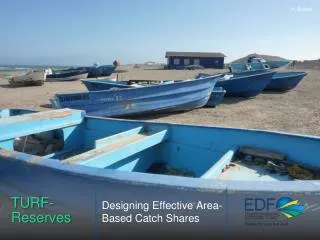
TURF-Reserves K. Beadle • Designing Effective Area-Based Catch Shares
What is a TURF-Reserve? Exclusive fishing privileges in a defined area Usually allocated to Cooperatives Accountable to catch limit or other controls on fishing mortality No-take reserve provides additional protections for fish stocks
Why TURFs? Enable local management Compatible with other spatial management Multi-species / ecosystem approach Benefit local communities Practical or accepted for some fisheries
No-take reserves • When TURFs are paired with no-take reserves • Fishermen in the TURF benefit from the no-take reserve • Fishermen are incentivized to enforce the no-take reserve K. Beadle
No-take reserves No-take reserve TURF TURF No-take reserve K. Beadle
Secure Exclusive All Sources Scaled Accountable Limited Transferable
Secure Exclusive All Sources Scaled Accountable Limited Transferable
Secure Exclusive All Sources Scaled Accountable Limited Transferable
Secure Exclusive All Sources Scaled Accountable Limited Transferable
TURFs are scaled appropriately Pescadores de Vigía Chico, Punta Allen, México Japanese Common Fishing Rights System flickr/mikemedia flickr/dmytton
Scaled Scaling according to the biology of the stock is important for sustainability
Scaled Scaling according to social factors affects incentives
Biological functional unit A self-sustaining fish stock
Social functional unit A group of people with the ability to organize
Punta Allen Spiny Lobster Cooperative, México (Sosa Cordero & Ramirez Gonzalez 1993)
Japanese common fishing rights system DTPs (Yamamoto 1995)
Scaled Coordination between TURFs can solve mismatches between biological and social functional units (Yamamoto 1995)
Secure Exclusive All Sources Scaled Accountable Limited Transferable
The role of Cooperatives Share responsibility Organize to fulfill responsibilities Ensure compliance with controls on fishing mortality and enforce boundaries K. Beadle
The role of Cooperatives • Share responsibility • Organize to fulfill responsibilities • Ensure compliance with controls on fishing mortality and enforce boundaries K. Beadle
Secure Exclusive All Sources Scaled Accountable Limited Transferable
Secure Exclusive All Sources Scaled Accountable Limited Transferable
Secure Exclusive All Sources Scaled Accountable Limited Transferable