Merge Sort
180 likes | 286 Vues
Merge Sort is a powerful sorting algorithm that employs the divide-and-conquer paradigm to efficiently sort data. This algorithm divides the input into two subsets, recursively sorts them, and then merges the sorted subsets to create a fully sorted sequence. With a time complexity of O(n log n), Merge Sort is highly suited for large datasets and is particularly effective for data stored on disks due to its sequential data access. This guide delves into the methodology, recursive structure, execution examples, and analysis of Merge Sort.


Merge Sort
E N D
Presentation Transcript
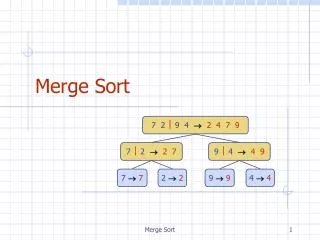
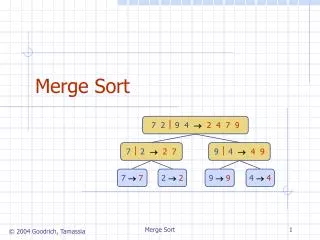
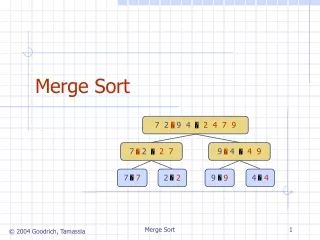
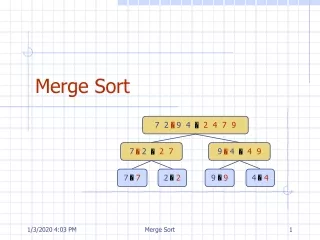
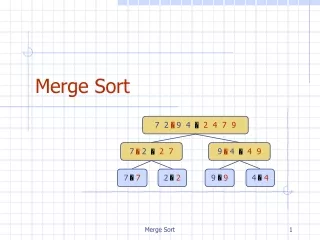
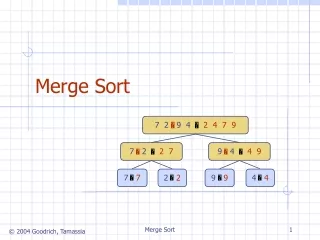
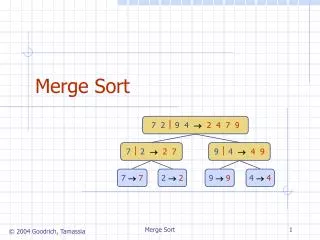
7 2 9 4 2 4 7 9 7 2 2 7 9 4 4 9 7 7 2 2 9 9 4 4 Merge Sort Merge Sort
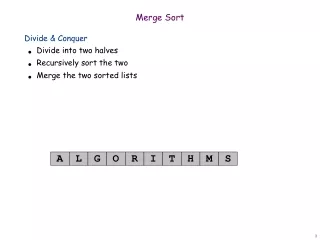
Divide-and conquer is a general algorithm design paradigm: Divide: divide the input data S in two disjoint subsets S1and S2 Recur: solve the subproblems associated with S1and S2 Conquer: combine the solutions for S1and S2 into a solution for S The base case for the recursion are subproblems of size 0 or 1 Merge-sort is a sorting algorithm based on the divide-and-conquer paradigm Like heap-sort It uses a comparator It has O(n log n) running time Unlike heap-sort It accesses data in a sequential manner (suitable to sort data on a disk) Divide-and-Conquer (§ 10.1.1) Merge Sort
Merge-sort on an input sequence S with n elements consists of three steps: Divide: partition S into two sequences S1and S2 of about n/2 elements each Recur: recursively sort S1and S2 Conquer: merge S1and S2 into a unique sorted sequence Merge-Sort (§ 10.1) AlgorithmmergeSort(S, C) Inputsequence S with n elements, comparator C Outputsequence S sorted • according to C ifS.size() > 1 (S1, S2)partition(S, n/2) mergeSort(S1, C) mergeSort(S2, C) Smerge(S1, S2) Merge Sort
Merging Two Sorted Sequences Algorithmmerge(A, B) Inputsequences A and B withn/2 elements each Outputsorted sequence of A B S empty sequence whileA.isEmpty() B.isEmpty() ifA.first().element()<B.first().element() S.insertLast(A.remove(A.first())) else S.insertLast(B.remove(B.first())) whileA.isEmpty() S.insertLast(A.remove(A.first())) whileB.isEmpty() S.insertLast(B.remove(B.first())) return S • The conquer step of merge-sort consists of merging two sorted sequences A and B into a sorted sequence S containing the union of the elements of A and B • Merging two sorted sequences, each with n/2 elements and implemented by means of a doubly linked list, takes O(n) time Merge Sort
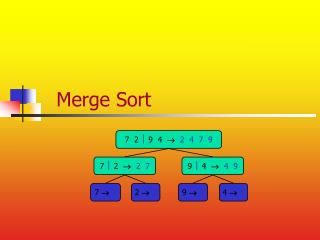
Merge-Sort Tree • An execution of merge-sort is depicted by a binary tree • each node represents a recursive call of merge-sort and stores: • unsorted sequence before the execution and its partition • sorted sequence at the end of the execution • the root is the initial call • the leaves are calls on subsequences of size 0 or 1 7 2 9 4 2 4 7 9 7 2 2 7 9 4 4 9 7 7 2 2 9 9 4 4 Merge Sort
7 2 9 4 2 4 7 9 3 8 6 1 1 3 8 6 7 2 2 7 9 4 4 9 3 8 3 8 6 1 1 6 7 7 2 2 9 9 4 4 3 3 8 8 6 6 1 1 Execution Example • Partition 7 2 9 4 3 8 6 11 2 3 4 6 7 8 9 Merge Sort
7 2 2 7 9 4 4 9 3 8 3 8 6 1 1 6 7 7 2 2 9 9 4 4 3 3 8 8 6 6 1 1 Execution Example (cont.) • Recursive call, partition 7 2 9 4 3 8 6 11 2 3 4 6 7 8 9 7 2 9 4 2 4 7 9 3 8 6 1 1 3 8 6 Merge Sort
7 7 2 2 9 9 4 4 3 3 8 8 6 6 1 1 Execution Example (cont.) • Recursive call, partition 7 2 9 4 3 8 6 11 2 3 4 6 7 8 9 7 2 9 4 2 4 7 9 3 8 6 1 1 3 8 6 7 2 2 7 9 4 4 9 3 8 3 8 6 1 1 6 Merge Sort
7 2 2 7 9 4 4 9 3 8 3 8 6 1 1 6 Execution Example (cont.) • Recursive call, base case 7 2 9 4 3 8 6 11 2 3 4 6 7 8 9 7 2 9 4 2 4 7 9 3 8 6 1 1 3 8 6 77 2 2 9 9 4 4 3 3 8 8 6 6 1 1 Merge Sort
Execution Example (cont.) • Recursive call, base case 7 2 9 4 3 8 6 11 2 3 4 6 7 8 9 7 2 9 4 2 4 7 9 3 8 6 1 1 3 8 6 7 2 2 7 9 4 4 9 3 8 3 8 6 1 1 6 77 22 9 9 4 4 3 3 8 8 6 6 1 1 Merge Sort
Execution Example (cont.) • Merge 7 2 9 4 3 8 6 11 2 3 4 6 7 8 9 7 2 9 4 2 4 7 9 3 8 6 1 1 3 8 6 7 22 7 9 4 4 9 3 8 3 8 6 1 1 6 77 22 9 9 4 4 3 3 8 8 6 6 1 1 Merge Sort
Execution Example (cont.) • Recursive call, …, base case, merge 7 2 9 4 3 8 6 11 2 3 4 6 7 8 9 7 2 9 4 2 4 7 9 3 8 6 1 1 3 8 6 7 22 7 9 4 4 9 3 8 3 8 6 1 1 6 77 22 9 9 4 4 3 3 8 8 6 6 1 1 Merge Sort
Execution Example (cont.) • Merge 7 2 9 4 3 8 6 11 2 3 4 6 7 8 9 7 2 9 42 4 7 9 3 8 6 1 1 3 8 6 7 22 7 9 4 4 9 3 8 3 8 6 1 1 6 77 22 9 9 4 4 3 3 8 8 6 6 1 1 Merge Sort
Execution Example (cont.) • Recursive call, …, merge, merge 7 2 9 4 3 8 6 11 2 3 4 6 7 8 9 7 2 9 42 4 7 9 3 8 6 1 1 3 6 8 7 22 7 9 4 4 9 3 8 3 8 6 1 1 6 77 22 9 9 4 4 33 88 66 11 Merge Sort
Execution Example (cont.) • Merge 7 2 9 4 3 8 6 11 2 3 4 6 7 8 9 7 2 9 42 4 7 9 3 8 6 1 1 3 6 8 7 22 7 9 4 4 9 3 8 3 8 6 1 1 6 77 22 9 9 4 4 33 88 66 11 Merge Sort
Analysis of Merge-Sort • The height h of the merge-sort tree is O(log n) • at each recursive call we divide in half the sequence, • The overall amount or work done at the nodes of depth i is O(n) • we partition and merge 2i sequences of size n/2i • we make 2i+1 recursive calls • Thus, the total running time of merge-sort is O(n log n) Merge Sort
Summary of Sorting Algorithms Merge Sort
Nonrecursive Merge-Sort public static void mergeSort(Object[] orig, Comparator c) { // nonrecursive Object[] in = new Object[orig.length]; // make a new temporary array System.arraycopy(orig,0,in,0,in.length); // copy the input Object[] out = new Object[in.length]; // output array Object[] temp; // temp array reference used for swapping int n = in.length; for (int i=1; i < n; i*=2) { // each iteration sorts all length-2*i runs for (int j=0; j < n; j+=2*i) // each iteration merges two length-i pairs merge(in,out,c,j,i); // merge from in to out two length-i runs at j temp = in; in = out; out = temp; // swap arrays for next iteration } // the "in" array contains the sorted array, so re-copy it System.arraycopy(in,0,orig,0,in.length); } protected static void merge(Object[] in, Object[] out, Comparator c, int start, int inc) { // merge in[start..start+inc-1] and in[start+inc..start+2*inc-1] int x = start; // index into run #1 int end1 = Math.min(start+inc, in.length); // boundary for run #1 int end2 = Math.min(start+2*inc, in.length); // boundary for run #2 int y = start+inc; // index into run #2 (could be beyond array boundary) int z = start; // index into the out array while ((x < end1) && (y < end2)) if (c.compare(in[x],in[y]) <= 0) out[z++] = in[x++]; else out[z++] = in[y++]; if (x < end1) // first run didn't finish System.arraycopy(in, x, out, z, end1 - x); else if (y < end2) // second run didn't finish System.arraycopy(in, y, out, z, end2 - y); } merge runs of length 2, then 4, then 8, and so on merge two runs in the in array to the out array Merge Sort