### Exploring the Dynamics of the Sun: Solar Rotation, Flares, and Stellar Connections ###
90 likes | 210 Vues
Delve into the captivating dynamics of the Sun, including its rotation, sunspots, and recent solar events. This lecture covers the impact of significant solar flares, such as the November 4, 2003 flare, and their potential consequences for Earth, including threats to geosynchronous satellites and astronauts. Additionally, we touch upon the nature of stars, addressing fundamental questions about distance, temperature, and composition, with a focus on parallax as a method for measuring stellar distances. Discover how our Sun compares to other stars in the universe. ###


### Exploring the Dynamics of the Sun: Solar Rotation, Flares, and Stellar Connections ###
E N D
Presentation Transcript
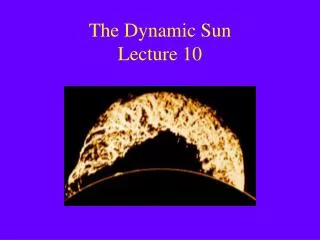
The Dynamic Sun • Solar rotation with sunspots http://science.nasa.gov/ssl/pad/solar/sunturn.htm • CME eruption http://science.nasa.gov/ssl/pad/solar/cmes.htm • Rotating Sun in X-rays http://www.solarviews.com/cap/sun/sxt.htm • Dynamics of coronal loops http://science.nasa.gov/ssl/pad/solar/loops.htm
Solar Events of Last October and November “The Day the Sun Went Wild”: Largest Flares Since the Space Age http://sohowww.nascom.nasa.gov/
The Flare of November 4, 2003 If directed at Earth, would have damaged system of geosynchronous satellites. Radiation would have killed astronauts in interplanetary space
The Stars “e quindi uscimmo a riveder le stelle” Last words of Dante’s Inferno
The Stars are other Suns Or…the Sun is the closest star
Basic Questions about Stars • How far away are they? • How hot are they? • How massive are they • What are they made of? • Do they have planets too? 16 Cygni
Most Basic Method of Stellar Distance Determination Trigonometric parallax: an ordinary surveying technique Figure 16.1 of textbook DEMO
Next time: • How far away are the stars (compared to solar system distances)? • What units do we use to describe their distances?