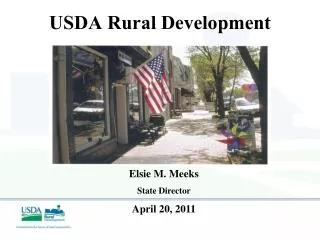
Enhancing Rural Economic Growth through Development Programs
Rural Development Programs aim to foster economic growth in rural areas by providing financial assistance, facilities, and infrastructure support. Key initiatives include the Business & Industry (B&I) loan guarantees, Rural Business Enterprise Grants (RBEG), and Value-Added Producer Grants (VAPG), which enhance job creation, support small businesses, and promote community facilities. Programs also focus on renewable energy, housing assistance, and cooperative development to meet the unique needs of rural communities, ultimately improving the quality of life for residents.

Enhancing Rural Economic Growth through Development Programs
E N D
Presentation Transcript
Rural Development Programs: • Business • Community Facilities • Housing • Single Family • Multi-Family
Business Programs Goal: To create or save jobs in rural areas.
Business & Industry (B&I) • Loan note guarantees up to 90% • Maximum Loan - $10,000,000 but possible to • go up to $25,000,000 with prior approval • from Washington D.C. • Loans are made by a commercial lender • and guaranteed by USDA
Rural Business Enterprise Grant (RBEG) Grants typically up to $100,000 Small and emerging businesses must be assisted with these funds State funding is usually around $1 million
2005 RBEGS - 16 projects funded Examples: Revolving Loan Fund – Development Authority of Macon County, Middle Flint Regional Development Authority, Schley-Sumter-Macon counties Joint Development Authority, Southwest GA United Empowerment Zone Streetscape, sidewalks, parking improvements – Harlem, Hartwell, Nashville, Social Circle, Sharpsburg Greenhouse– Okefenokee Technical College Purchase truck driving simulator – Griffin Technical College, Ogeechee Technical College Results - 487 jobs
Rural Business Opportunity Grant (RBOG) • Purpose: for technical assistance, training and planning to promote economic development • Grants typically under $50,000 (Multi-state - $150,000) • For public body, nonprofit, or cooperative serving town with less than 10,000 inhabitants • Must result in economic development
Intermediary Relending Program (IRP) • Loan to intermediary at 1% interest • Intermediary sets own rates • 10 Intermediaries in the State
Intermediaries • Appalachian Community Enterprises, Inc. • Central Savannah River Area Rural Lending Authority, Inc. • Coastal Area District Development Authority • Fort Valley State University Foundation, Inc. • Georgia Mountains Regional Economic Development Corp. • Georgia Small Business Lender, Inc. • Middle Flint Area Development Corporation • South Georgia Area Resource Development • Small Business Assistance Corp. • Southeast Local Development Corp. FY05 – 1 project funded $600,000 Result: 80 jobs
Rural Economic Development Loan and Grant Program • 0% Interest Loans • Grants available • Electric or telecommunications cooperatives for community and economic development FY 05 – 3 projects funded $1,930,000 Results: 119 jobs
Value-Added Producer Grants The Value-Added Producer Grant (VAPG) Program is intended to provide grant funds to agricultural producers for planning activities and working capital expenses to assist them in receiving a greater share of the consumer’s dollar for value-added agricultural products.
Value-Added Producer Grants • Application period for FY ’06 closed on March 31. • Maximum Grant • Working Capital - $300,000 • Planning - $150,000 • $19.45 million was available nationwide
Renewable Energy & Energy Efficiency Loans and Grants • Purchase renewable energy systems (A process that produces energy) • Improvements to a facility or process that reduces energyconsumption
Renewable Energy & Energy Efficiency Loans and Grants • Maximum grant is $500,000 for a RE system and $250,000 for EE Improvement • Grant cannot exceed 25% of eligible project costs • Application deadline for FY ’06 was May 12. • $11.3 million was available this year
Renewable Energy & Energy Efficiency Loans and Grants • Loan cannot exceed 50% of project costs • Maximum loan is $10 million • Percentage of Guarantee • 85% for loans under $600,000 • 80% for loans between $600,00 & $5 million • 70% for loans over $5 million • Guarantee Fee – 1% • Annual Renewal Fee – maximum is .5% but is determined each year
Cooperative Development • Technical assistance to co-ops, including: • Feasibility studies • Business plans • Help establishing a new co-op
Rural Cooperative Development Grant (R.C.D.G.) 1 project funded $294,897 invested Funds were used to continue the operation of the Georgia Cooperative Development Center. This is a partnership between the Georgia RC&D Councils, the Center for Agribusiness and Economic Development at UGA and USDA Rural Development.
Community Programs • Water and sewer programs • Solid waste facilities • Technical assistance • Community Facilities • FY2005 Investment: over $44 million
Clean running water for Rural Georgians • Replacement of old systems • Expansion of inadequate systems • Installation of new systems • Loans and grants available
Infrastructure – • Almost $30 million invested • Will serve 2,881 households in five 44 communities Community Program
Community Facilities • Provide essential services in rural areas and towns • Guaranteed and direct loans are available • Limited grant funds available
Distance Learning and Telemedicine • Loans between $50,000 and $10 million and loan/grant combinations • Deadline: None • Grants between $50,000 and $500,000 • Deadline: Published in NOFA annually • Watch for NOFA for 2007!
Housing • Single Family • Multi-Family
Single Family Housing • 100% of purchase price, not to • exceed the market value or maximum loan amount for the area. • Loans are available to very-low, low and moderate income families
Multi-Family • Rural Rental Housing loans provide economically designed housing for very-low, low, and moderate income families, the elderly, and the handicapped • 500 apartment complexes totaling 16,500 apartments • over $18 million a year in rental assistance to families in extreme need
FY 2005 Loan And Grant Programs Almost $566 million invested in GA
FY 2005 • 727 people bought a home • 410 homes repaired • water or waste funds for five communities serving 2,881 households and two wholesale distributors • created or saved 1,629 jobs • over 8,385 families received rental assistance