Download
1 / 16
170 likes | 317 Vues
This presentation by Sarah Shaquoya and Nick explores natural gas as a critical energy source. It covers nonrenewable energy locations, access challenges, and the consequences of fossil fuel usage. The discussion includes the costs associated with natural gas compared to oil and coal, viable alternative energy sources, and the political environment around energy resources. The presentation highlights the advantages and disadvantages of natural gas, emphasizing its lower carbon emissions and growing consumption projected through 2040.

E N D
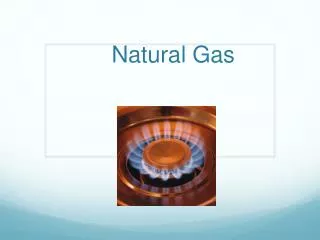
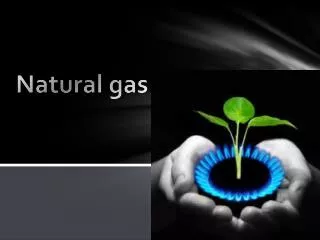
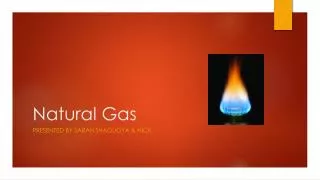
Natural Gas Presented by Sarah Shaquoya & Nick
Questions to Consider • Where are the nonrenewable sources of energy located? • How easy is it to gain access to these sources? • What are the consequences of using these sources (fuels)? • What are the costs (direct and indirect) of using these sources? • Are there viable alternative sources of fuel? • What is the current cost of crude oil and other forms of energy? • What else have you learned about these resources? • What is the political environment for these energy sources?
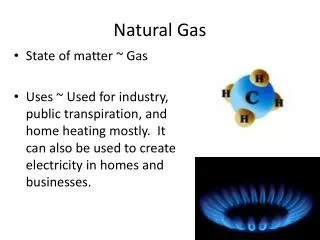
Fossil fuel Gas with mixtures of methane, carbon and other chemicals Energy source Beneath the earth Natural Gas
Usage • Power generation • Fertilizer • 260,000 homes across the North Island for cooking, space and central heating. • Commercial Applications: hotels, motels, restaurants, office buildings
Sources& Methods • Drilling • Coal beds • Shale • Power plants
Fracturing http://www.youtube.com/watch?v=VY34PQUiwOQ
Cost • Natural gas still has relatively low capital costs and favorable heat rates for new power generation plants over oil and coal. • The extraction of oil and coal is too expensive compared to the many different ways that natural gas can be produced. • Cost of natural gas is slowly increasing as consumption is also increasing each year
Future Outlook • World energy consumption is estimated to grow by 56 percent from 2010 to 2040. • Global natural gas consumption increases by 1.7 percent per year. • By 2040, the natural gas consumption is expected to grow by nearly 64% globally. • Emergence of more developing countries • Natural gas is estimated to grow in production due to: • Technological innovations • New reserve discoveries
Storage & Transport • Low density: not easy to store or transport by vehicle • Underground
Advantages • Burns clean compared to cola, oil (less polluting) • 70% less carbon dioxide compared to other fossil fuels • helps improve quality of air and water (not a pollutant) • does not produce ashes after energy release • has high heating value of 24,000 Btu per pound • inexpensive compared to coal • no odor until added
Disadvantages • Not a renewable source • Finite resource trapped in the earth (some experts disagree) • Inability to recover all in-place gas from a producible deposit because of • Unfavorable economics and lack of technology • It costs more to recover the remaining natural gas because of flow, access • Combustible • Toxic
Saftey • Never keep flammable liquid or any combustible material near your furnace or water heater • Maintain pipes • Install earthquake valves on your house piping that will automatically shut off gas in the event of an earthquake
Discussion • Any Questions ????
Works Cited • Natural Gas." EPA. Environmental Protection Agency, n.d. Web. 18 Sept. 2013. • "Natural Gas." Natural Gas. N.p., n.d. Web. 18 Sept. 2013. • "U.S. Natural Gas Prices." U.S. Natural Gas Prices. N.p., n.d. Web. 18 Sept. 2013. • http://www.eia.gov/forecasts/steo/report/natgas.cfm • http://www.eia.gov/forecasts/ieo/nat_gas.cfm