Quantum Chromodynamics
This presentation explores Quantum Chromodynamics (QCD), the theory of strong interactions among quarks and gluons. We trace its historical development from the 1950s, discussing the discovery of hadrons and the emergence of quarks as fundamental particles. The significance of color charge, asymptotic freedom, and the challenges of quark confinement are examined. Additionally, we consider the technological implications for research and the role of lattice QCD in verifying theoretical predictions. Join us for a thorough understanding of this crucial aspect of particle physics.

Quantum Chromodynamics
E N D
Presentation Transcript
Quantum Chromodynamics John Christie & Jude Rowe Santa Rosa Junior College Physics 43 Spring 2009
What we will be discussing • A Brief History of QCD • What is QCD? • Implications
History of QCD • Early 1950’s: Discovery of Hadrons inside “Elementary Particles” • Attempts to sort particles using QED, strangeness, led to Eightfold Way • 1963: Theory of smaller particles inside Hadrons called partons, or Quarks.
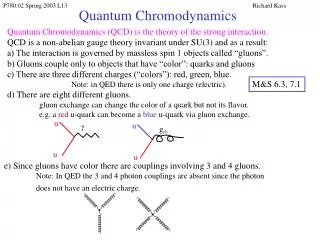
Creation of QCD Δ++ particle and Ω- had three quarks with parallel spin, violating the Pauli exclusion principle • Proposal by Han, Nambu, and Greenburg that these quarks had an additional degree of freedom, “color charge”. • Experiments later verified existence of gluons, exchange particles that carry said “color charge”
What is QCD? • QCD was created based on QED’s inability to explain all quark interactions Eightfold Way of Mesons Color Chart
Numerical Analysis • To calculate QCD we use equations similar to Boltzman equations • …faster computers are required in order to mathematically model and compute these interactions
Implications of QCD • Defines a new quantum number through Asymptotic freedom • Grand Unified Theory • Increased demand on technology for research and verification of QCD
Proving QCD? • Confinement prevents direct observation of free Quarks and Gluons • Some verification of QCD using CERN (a few percent) • Lattice QCD computations theoretically predict but not analytically prove QCD theory • Phases of Quark Matter
Phases of Quark Matter Temperature Chemical Potential
Resources • http://arxiv.org/PS_cache/hep-ph/pdf/0408/0408206v1.pdf • http://www.experiencefestival.com/a/Quantum_chromodynamics_-_History/id/4694211 • http://www.aps.org/publications/apsnews/200412/nobel.cfm • http://www.aps.org/publications/apsnews/200403/qcd.cfm • http://www.aps.org/units/ghp/gallery/qcd.cfm • http://google1.aps.org/search?q=QCD+history&btnG=Google+Search&entqr=0&output=xml_no_dtd&sort=date%3AD%3AL%3Ad1&entsp=a&client=default_frontend&ud=1&y=0&oe=UTF-8&ie=UTF-8&proxystylesheet=default_frontend&x=0&site=default_collection • http://www-spires.slac.stanford.edu/cgi-bin/spiface/find/hep/www?FORMAT=WWW&rawcmd=fin+au+Altarelli%2CG • http://www-d0.fnal.gov/~d0qcd/QCD_theorists.html • http://www-d0.fnal.gov/public/links/index.html • http://www-d0.fnal.gov/Run2Physics/WWW/results/summary.htm • http://www-d0.fnal.gov/Run2Physics/qcd/ • http://physics.nmt.edu/~raymond/classes/ph13xbook/node210.html • http://en.wikipedia.org/wiki/Quantum_chromodynamics • Thorton, Stephen T. Modern Physics for Scientists and Engineers. 3rd Ed.