Download
1 / 8
80 likes | 220 Vues
Explore the fascinating world of cell organelles, including mitochondria, which convert chemical energy from food into usable forms for cells. Discovered in the 1600s, mitochondria come with a complex array of working components. Delve into the role of the nucleus, surrounded by its nuclear envelope, which houses the nucleolus and is vital for protein synthesis. Additionally, learn about cell walls and molecular movement through diffusion and endocytosis, the process by which large particles are transported into cells.

E N D
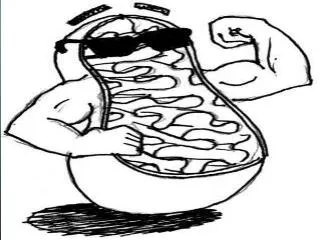
Which organelle converts chemical energy (stored in food) into compounds that are more convenient for the cell to use mitochondrion
-First discovered in 1600s-contain a huge array of working parts-can be found in pond waterwhat is it? A cell
Type of microscope that can reveal details 1000 times smaller than those in a light microscope electron
-come in diff. shapes and sizes-some have a nucleus and some don’tWhat is it??? A cell
-has a nucleolus (to make ribosomes)-codes for instructions to make a proteinsurrounded by a nuclear envelope (lets things in and out)what is it? A nucleus
These are always moving and colliding with one another(results in diffusion) Molecules (particles)
Large particles being brought into the cell(picture on board) endocytosis