Introduction to Calculating Limits | Learn How to Find Limits of Function Values
100 likes | 191 Vues
Understand how to calculate limits, define limits, explore function behavior near points, and find limits using tables and graphs. Discover limit laws and when limits do not exist.


Introduction to Calculating Limits | Learn How to Find Limits of Function Values
E N D
Presentation Transcript
Introduction to Limits OBJECTIVE: Calculate a limit
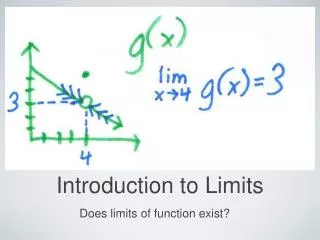
Limits of Function Values • Definition of Limit: • If becomes arbitrarily close to a unique number as approaches from either side, the limit of as approaches is . This is written as • Frequently when studying a function, we find ourselves interested in the function’s behavior near a particular point, but not at that point. • Exploring numerically how a function behaves near a particular point at which we cannot directly evaluate because the function leads to division by zero.
Finding a limit by using a table of values • Use a table to estimate numerically the limit. • 1. • 2.
Finding a limit by using a table of values • 3. • 4. • 5.
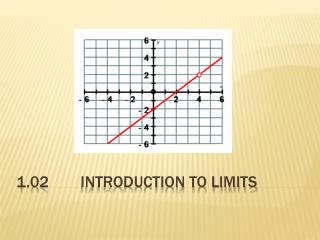
Finding a limit by using a graph • Using a calculator to guess the limit numerically as x gets closer and closer to c. You discover the behavior of a function near the x-value at which you are trying to evaluate a limit. But sometimes calculators can give false values and misleading impressions for functions that are undefined at a point or fail to have a limit there, because the calculator connects pixels and can’t show the infinitely many oscillations over any interval that contains 0. • 6. 7.
Finding a limit by using a graph • 8. • 9. • Windows x-min = -0.25 and x-max = 0.25 and xscl = 0.05, y-min = -1.2 and y-max = 1.2 and yscl = 0.2
Conditions under which Limits Do Not Exist • The if any of the following conditions is true. • It jumps: approaches a different number from the right side of c than from the left side of c. • It grows too “large” or too “small” to have a limit: increases or decreases without bound as x approaches c. • It oscillates to much to have a limit: oscillates between two fixed values as x approaches c.
Limit Laws • If are real numbers and • 1. Sum Rule: • 2. Difference Rule: • 3. Constant Multiple Rule: • 4. Product Rule: • 5. Quotient Rule: • 6. Power Rule: • 7. Root Rule:
EX: Find the following limits • 10. • 12. • 11. • 13.