L1Calo PreProcessor Module
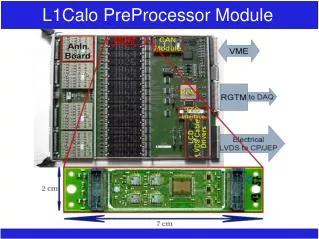
We aim to create a pin-size and latency-compatible substitute for the existing MCM utilizing state-of-the-art components. Our design includes the AD9218 dual 105 MHz 10-bit FADC and the Xilinx Spartan-6 FPGA in a compact CSG324 package. This modern reconfigurable device allows for integration of ASIC functionalities and the flexibility to add new preprocessing algorithms, such as event-by-event pedestal subtraction and advanced BCID algorithms, to enhance performance for higher luminosity post-LHC upgrade. The design is focused on standard and simple production technologies.

L1Calo PreProcessor Module
E N D
Presentation Transcript
New MCM • We would like to develop a pin-, size- and latency-compatible substitute for the MCM based on today's components: • AD9218 -- dual 105\,MHz 10\,bit FADC • Xilinx Spartan-6 (SC6SLX45) FPGA in the CSG324 (15x15) package • Functionality of ASIC, PHOS4 and LVDS Serialisers inside FPGA Modern reconfigurable device will allow us to adjust and to add new pre-processing algorithms (event-by-event pedestal subtraction, more sophisticated BCID algorithms, etc.) for higher luminosity expected after the LHC Upgrade
LVDS Serializers • 480Mb/s serialisers for LVDS are implemented using Spartan-6 output serialiser blocks (OSERDES2). Eye-diagram shows a good signal quality:
PprASIC • PprASIC (including serializers) verilog code is adopted and synthesized for the Spartan-6 FGPA. • Estimated power consumption: • FPGA: ~200 mW • ADC: ~275 mW per channel at 105MHz; ~1W on module
nMCM PCB Layout • 10 layers design • Aim is to keep production technology as ''standard-and-simple'' as possible