Download
1 / 8
80 likes | 200 Vues
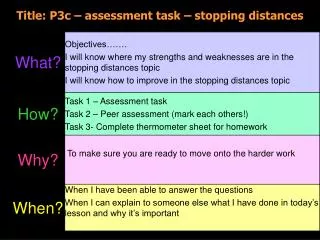
Safe stopping distance (SSD) is crucial for preventing accidents on the road. It encompasses the distance a driver can see ahead and effectively bring their vehicle to a halt. SSD consists of two main components: the time required for a vehicle to decelerate and stop, which is influenced by the vehicle's speed, and the reaction time of the driver—how long it takes to notice the need to stop and engage the brakes. The formula for calculating safe stopping distance is d = V^2 / (2a), where 'd' is the distance in feet, 'V' is the vehicle speed in feet per second, and 'a' is the deceleration rate of 11.2 feet per square second.

E N D
Safe Stopping DistancesBob Williams 2009 UNL Science & Math Technology Institute
A major factor in preventing accidents is stopping sight distance. This refers to how far ahead a driver can see and be able to bring the vehicle to a stop. There are two components in stopping sight distance, or SSD. One is how long it takes the vehicle to decelerate and stop, this is affected by the speed of the vehicle primarily. The other is how long it takes the driver to see the need to stop and actually apply the brakes. The formula for safe stopping distance is given by: d = V2 2a where d: deceleration distance in feet V: vehicle speed in feet per second a: 11.2 feet per square second, based on research