
Wind and Wind Patterns Chapter 2.2 Guided Notes
E N D
Presentation Transcript
What is Weather? • Weather is the condition of Earth’s atmosphere at a particular time and place. What is Wind? • Wind is air moving across the surface of the Earth. It can move horizontally or parallel to the ground. Bill Nye- Wind
What causes wind? • Uneven heating of the Earths surface causes air pressure to differ from place to place. • This difference in pressure sets air in motion. Air moves from places of higher air pressure to areas of lower air pressure. This is wind!
How Wind Forms • Sunlight strongly heats an area of the ground. The ground heats the air. The warm air rises, and an area of low pressure forms. • Sunlight heats an area of ground less strongly. The cooler, dense air sinks slowly, and an area of high pressure forms. • Air moves as wind across the surface, from higher towards lower pressure.
Why does the Sun heat the Earth unevenly? • Since the Earth is round, the suns energy does not evenly reach and heat the Earth. • Sunlight is concentrated near the equator because it strikes it directly. • Sunlight is more spread out near the poles because it strikes at a lower angle.
The Earth is heated unevenly, so what? • Uneven heating between the equator and the poles causes global winds. • Since the Earth is round, the sun’s energy doesn’t evenly reach and heat the Earth. • Sunlight is concentrated near the equator because it strikes it directly. Warm air rises, producing low pressure.
The Earth is heated unevenly, so what? • Sunlight is more spread out near the poles because it strikes at a lower angle. • Because less sunlight reaches here, the air is cooler and denser. • The sinking dense air produces high pressure that sets global winds in motion.
How does Earth’s rotation effect wind? • If Earth didn’t rotate, global winds would flow directly from the poles to the equators. • But Earth’s rotation changes the direction of the wind. This is called the Coriolis Effect. • Global winds curve as Earth turns beneath them. • Winds in the Northern Hemisphere curve to the right. • Winds in the Southern Hemisphere curve to the left. • The Coriolis Effect is only noticeable for winds traveling long distances.
Coriolis Effect http://www.youtube.com/watch?v=7TjOy56-x8Q
What are Global Winds? • The distances winds travel varies. • Some winds die out quickly and travel short distances. • The winds that travel thousands of miles and are able to last for weeks are called Global Winds. • The Coriolis Effect prevents the winds from flowing directly from the poles to the equator, causing them to move in three routes, called global wind belts. http://www.youtube.com/watch?v=jLiDZOqFqD8
Circulation Cells • A giant loop of moving air. • Includes a wind belt and the calm regions that border it. http://www.youtube.com/watch?v=6lqWE74ve5U
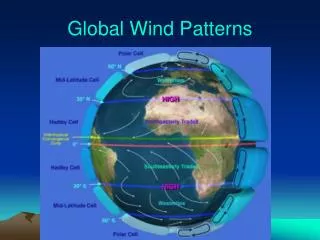
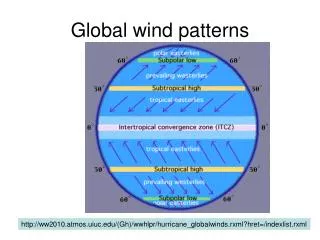
Wind Belts • Dense air sinks in high pressure areas and it flows out to areas of low pressure. • This pattern produces three global wind belts in each hemisphere. • Because of the Coriolis Effect, winds curve toward the east or west. Some global wind belts are named for the direction from which they blow.
Wind Belts • Trade Winds- • Blow from the east • Move from the horse latitudes toward equator • Strong and steady but die as they reach equator • Westerlies • Blow from the west • Move from the horse latitudes toward the poles • Bring storms across much of US • Easterlies • Blow from the east • Move from polar regions toward mid-latitudes • Stormy weather often occurs when cold air of easterlies meets warm air of westerlies
Calm Regions • Earth’s rotation and uneven heating of its surface cause a pattern of wind belts separated by calm regions. • Each calm region is a zone of either high or low pressure. • Winds are light and they often change direction. • Doldrums- low pressure zone near equator. • Warm air rises to top of troposphere • Air spreads out towards poles • Rising, moist air produces clouds and heavy rains • Heavy evaporation from warm ocean water fuels tropical storms • Horse latitudes- high pressure zones 300N and 300S of equator • Warm air traveling from equator cools and sinks here • Weather tends to be clear and dry
Model of the Earth with all wind belts, convection cells, and calm regions.
Wind and Travel • Sailors have sought out and relied on global wind belts for centuries, using the trade winds to move from Europe to N America, and the westerlies to return home. • Air travel time can be lengthened or shortened by jet streams.
Not all winds travel along Earth’s surface! • Jet Streams are long-distance winds that travel in the upper troposphere. • They travel long distances from west to east. • They travel at 124 miles per hour! Yep, that’s fast. • Form due to uneven heating of Earths surface, like global winds. • Flow in a wavy pattern around the Earth. • Each Hemisphere has two. • Affect air travel times. Usually flow 6-9 miles above Earth’s surface- airplane travel times can be lengthened or shortened by jet streams.
Types of Jet Streams • Polar Jet Streams- flow closer to the poles. • Pull cold air toward Equator and warm air up toward poles. • Strong storms form along its loop. • Have strong influence on N America’s weather • Subtropical jet streams- flow closer to equator. http://www.youtube.com/watch?v=CgMWwx7Cll4
The Gulf Stream • Warm Atlantic Ocean current traveling north • Influences climate of N America’s east coast and Europe’s west coast. • The warm Gulf Stream waters from FL combine with the cold winds from the north. This brings dense fog and immense heat transfer causing intense storms.
The Gulf Stream http://www.youtube.com/watch?v=m-zO8L66uyg
Local Winds • Change daily within a regular pattern and blow within small areas. • Sea breezes and land breezes occur near shorelines. • Sea breezes- During the day, land heats up faster than water. Air over the land rises and denser ocean air (high pressure) moves toward the area of low pressure. • Land breezes- During the night, land cools faster than water. Warm air rises over the ocean and cooler air flows in, producing a land breeze.
SEA BREEZE • LAND BREEZE http://www.youtube.com/watch?v=ZQV72Yzmjyc
Valley/Mountain Breezes • Mountain slopes heat up and cool faster than the valleys below them. • During the day, valley breezes flow up mountains- mountain breezes • During the night, mountain breezes flow down into valleys- valley breezes
http://www.youtube.com/watch?v=MNJ9A3x4rAY Monsoons • Winds that change direction with the seasons. • Caused by different heating and cooling rates of land and sea. • Winter monsoons occur in areas where land becomes much cooler than the sea. High pressure builds over the land and cool, dry winds blow out to the sea. • Summer monsoons occur when land becomes warmer than the sea. Moist wind blows from the sea over the land, bringing heavy rains. • Most extreme monsoons occur in S and SE Asia. Farmers depend on this rain to grow their crops!