Download
1 / 10
100 likes | 217 Vues
This analysis explores how the merger between Waterstone's and Ottakar's affects non-price features such as the range of titles and service quality in book retailing. With Waterstone's possessing 190 stores and Ottakar's having 141, the study examines overlapping locations and competition dynamics. Findings indicate no significant uplift in the range or service quality due to the merger. It highlights the importance of considering non-price factors alongside price competition, especially in a market increasingly influenced by supermarkets and online retailers.

E N D
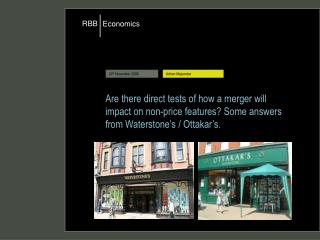
Adrian Majumdar Are there direct tests of how a merger will impact on non-price features? Some answers from Waterstone’s / Ottakar’s.
Waterstone’s / Ottakar’s • The merging firms – specialist book retailers • Waterstone’s • 190 stores in the UK • Ottakar’s • 141 stores in the UK • 33 overlap areas (stores within the same shopping location), mainly outside London
National shares for book retailers (2005) Source: Table 1, National book market shares, 2005, Final CC report
Product market • retailing of new books to consumers (CC) • Both CC and OFT recognised potential differentiation by: • sales channel: e.g. bricks and mortar vs internet vs book clubs • store: “Large range” vs. “Small range” retailers (e.g. stock 10,000 titles or fewer vs the rest) • book category: “Deep range” vs. Best seller titles, i.e. top 5,000 vs the rest
Geographic Market (1) • National features of competition • homogenous pricing throughout UK for most booksellers • most “deep range” titles sold at RRP set by publishers • Diversion ratio analysis indicated that national market shares reasonable indicators of competitive pressure – no reduction in national rivalry in price
Geographic Market (2) • Potentially local features of competition which could be harmed: • Range of titles stocked • Quality of service offered
A direct test of harm on range • Does O’s presence have an impact on W’s range after controlling for other factors that may have an effect (and vice versa), e.g. • W’s range = function of: local population, store size, presence of O’s • No finding of a robust statistically significant uplift in range when the other party is present • W’s provided evidence that the merger could lead to an increase in range through synergies
A direct test of harm on service quality • Does O’s presence have an impact on W’s service quality after controlling for other factors that may have an effect (and vice versa) • Measures of service considered: • staff levels • staff experience • opening hours • refurbishments • book signings • No finding of a robust statistically significant uplift in service indicators when the other party is present for any measure… other than perhaps book signings
Book signings – a good measure? • Service quality measure should be: • important in determining consumers’ choice of store; and • representative of other important aspects of service quality determined by the merging parties • Book signings fails on both counts: • rank v low on scale of attributes valued by consumers • not always a retailer decision
The forgotten dimension? • Competition in non-price factors should not be viewed in isolation from price competition • pincer movement… growth of supermarkets and internet would force W’s and O’s to differentiate themselves by good range and service