Transaction Management
This overview explores transaction management, focusing on ACID properties—Atomicity, Consistency, Isolation, and Durability. It highlights the differences between pessimistic and optimistic concurrency control techniques. Pessimistic techniques involve locking to prevent conflicts during read/write operations, while optimistic techniques validate conflicts only at the commit phase, enhancing performance. Additionally, the role of database recovery tools and how they relate to transaction management is discussed. This guide is essential for those seeking to grasp effective transaction management and control in database systems.

Transaction Management
E N D
Presentation Transcript
1. Transaction Management by Benjamin Nguyen
2. Overview Transaction
Properties of transaction
Pessimistic & optimistic techniques
Locking
No lock techniques
Oracle recovery tools
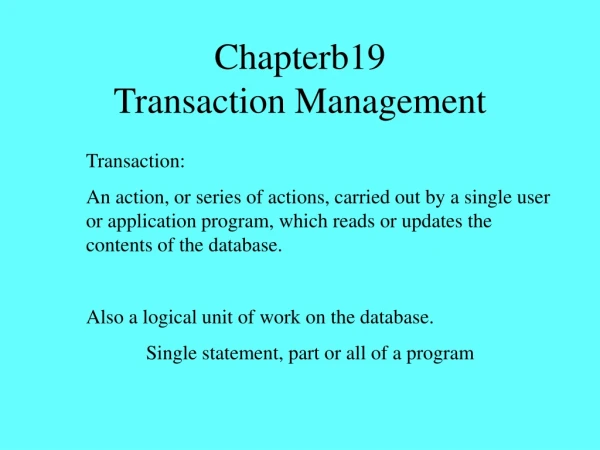
3. Transaction An action, or series of actions, carried out by a single user or application program, which reads or updates the contents of the database
4. Properties of Transaction ACID
Atomicity: ‘all or nothing’ property. (Responsible by DBMS recovery subsystem)
Consistency: database must be transform from one consistent state to another consistent state.
5. Properties of Transaction (cont.) ACID
Isolation: transaction execute independently of one another. (Responsible by concurrency control)
Durability: The effects of a successfully completed (committed) transaction are permanently recorded in the database and must not be lost because of a subsequent failure (Responsible by recovery subsystem)
6. Over view of Database
7. Pessimistic & Optimistic techniques Pessimistic
Check for conflict when read/write
Optimistic
Only check for conflict when the transaction wishes to commit
8. Pessimistic & Optimistic techniques Pessimistic
Using locking techniques
Optimistic
The concurrency control that does not use lock and it involve the following phases:
Read phase
Validation phase
Write phase
9. Optimistic Techniques