Download
1 / 4
50 likes | 183 Vues
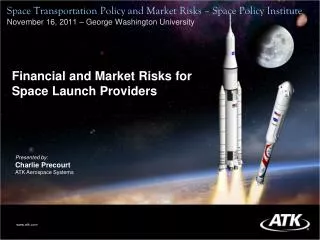
This presentation from the Space Policy Institute discusses the operational and market challenges faced by space launch providers. Key issues include the high costs associated with extreme operating conditions, limited market size, and difficulties in recouping development costs. The analysis highlights the broad mission requirements and the need for multiple vehicle designs to satisfy diverse customer needs. Effective business practices and lessons from past programs are emphasized to foster a sustainable launch industry, focusing on improved reliability and efficiency.

E N D
Space Transportation Policy and Market Risks – Space Policy Institute November 16, 2011 – George Washington University Financial and Market Risks for Space Launch Providers Presented by: Charlie Precourt ATK Aerospace Systems www.atk.com
Overarching Considerations for Launchers • Physics Very Challenging and Unchanging • Operating environments extreme. Temperatures, loads, pressures, and rapid variations of these conditions lead to highly costly systems solutions. • Dramatic Advances in propulsion and materials properties elusive, yet necessary to dramatically lower the costs of “managing the physics” • Market Relatively Small • Flight rates much greater than six per year are rarely achieved for any sizable launch system • Difficult to recoup development costs, resulting in high unit cost in proportion and infrastructure carrying costs high on a per flight basis • Managing market risks exacerbates business model: flight losses, indemnification, payload or system delays/stand-downs, manifesting challenges Broad set of mission requirements – Attributes sought often mutually exclusive • LEO vs. GTO design • Low payload weight or volume vs. heavy or large volume • Low cost: per pound, per flight, or per year • Multiple designs required/emerge to meet the wide spectrum of all customer needs. • Synergies remain a challenge; yet where found and exploited, can reduce LV financial and market risks Consequences • Customer: government vs. commercial • Safety, reliability and availability • Cargo/satellite vs. human rated Consequences
Launch Industry Snapshot • Difficult Business Case • Difficult to forecast market • Limited customer base • Launch and payload schedule slips • Limited competition • Difficult for new entrants • 18 U.S. launches in 2011; only one was commercially-funded • Key • Yellow – 0-3 month slip • Orange – 3-6 month slip • Brown – 6- 12 month slip • Red – 1 year or more slip In 2011 there were a total of 48 international launches (with 3 failures); 10 of those were commercially-funded.
Summary • U.S. launch industry faces many challenges • Industrial base has been dramatically affected by market realities in recent years • Opportunities exist for improved business practices to lead to a sustainable launch industry • Leverage lessons learned from DoD and NASA development programs • Ensure business case closes for new vehicle developments before “launching” into them • Leverage existing assets, workforce and infrastructure wherever practical • Emphasize the importance of continuous improvement in reliability, safety, manufacturability, performance, launch availability, and system costs 3