
Glyptotherium floridanum: An Enigmatic Pleistocene Herbivore
Glyptotherium floridanum, a member of the Glyptodontidae family, roamed North America during the late Pleistocene before becoming extinct. Originating in South America, this remarkable herbivore is noted for its tortoise-like armor composed of osteoderms. Fossils have been discovered across Texas, Florida, Arizona, and Oklahoma, with significant finds at Millennium Park, including 328 specimens. Notable features include their heavy short limbs, inability to retract their heads, and a distinct rodent-like chew pattern. They are characterized by sexual dimorphism, particularly in size.
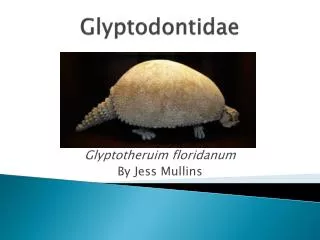

Glyptotherium floridanum: An Enigmatic Pleistocene Herbivore
E N D
Presentation Transcript
Glyptodontidae Glyptotheruim floridanum By Jess Mullins
Scientific Classification Kingdom: Animalia Phylum: Chordata Class: Mammalia Superorder: Xenarthra Family: Glyptodontidae Genus: Glyptotherium (At Millennium Park) Species: G. floridanum
About the Family • Alive during late Pleistocene and went extinct by end of Pleistocene • Originated in South America and moved into North America • 1 Genus, 3 Species • Fossils in N. America have been found in Texas, Florida, Arizona and Oklahoma
Glyptotherium • Tortoise like armor made of osteoderms • Fusion of vertebrae and pelvic girdle to carapace • Heavy short pillar limbs
Behavior • They could NOT pull head into shell • 32 teeth – rodent like chew pattern • Sexual Dimorphism (just G. floridanum) • Herbivore
At Millennium Park Site: • 328 specimens found • 2 mandibles, 326 osteoderms • G. floridanum only- are distinguished by their slightly smaller size
http://www.bbc.co.uk/nature/life/Glyptodontidae • Kurten, Björn, and Elaine Anderson. Pleistocene Mammals of North America. New York: Columbia University Press, 1980. 358. Web. 10 Jan. 2013. • Feldhamer, George, ed. Mammalogy: Adaptation, Diversity, Ecology. N.p.: n.p., n.d. 304. Web. 10 Jan. 2013.