Download
1 / 28
290 likes | 410 Vues
Inverse functions represent a unique relationship where the output of one function becomes the input of another, effectively "undoing" the original function. This section discusses the key principles, including the characteristics of one-to-one functions, the horizontal line test, and how to find inverse functions using examples such as f(x)=7x-1 and f(x)=9/5x+32. By exploring the graphs of functions and their inverses, we illustrate how points are symmetric about the line y=x. Understanding these principles is crucial in various mathematical applications, particularly in converting temperature scales.

E N D
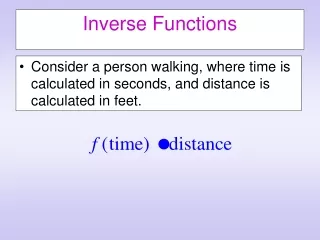
The function f is a set of ordered pairs, (x,y), then the changes produced by f can be “undone” by reversing components of all the ordered pairs. The resulting relation (y,x), may or may not be a function. Inverse functions have a special “undoing” relationship.
Relations, Functions & 1:1 1:1 Functions are a subset of Functions. They are special functions where for every x, there is one y, and for every y, there is one x. Relations Functions 1:1 Functions Reminder: The definition of function is, for every x there is only one y. Inverse Functions are 1:1
Example Find the inverse of f(x)=7x-1
The Horizontal Line Test And One-to-One Functions
Horizontal Line Test b and c are not one-to-one functions because they don’t pass the horizontal line test.
Example Graph the following function and tell whether it has an inverse function or not.
Example Graph the following function and tell whether it has an inverse function or not.
There is a relationship between the graph of a one-to-one function, f, and its inverse f -1. Because inverse functions have ordered pairs with the coordinates interchanged, if the point (a,b) is on the graph of f then the point (b,a) is on the graph of f -1. The points (a,b) and (b,a) are symmetric with respect to the line y=x. Thus graph of f -1 is a reflection of the graph of f about the line y=x.
Example If this function has an inverse function, then graph it’s inverse on the same graph.
Example If this function has an inverse function, then graph it’s inverse on the same graph.
Example If this function has an inverse function, then graph it’s inverse on the same graph.
Applications of Inverse Functions The function given by f(x)=9/5x+32 converts x degrees Celsius to an equivalent temperature in degrees Fahrenheit. a. Is f a one-to-one function? Why or why not? F=f(x)=9/5x+32 is 1 to 1 because it is a linear function. b. Find a formula for f -1 and interpret what it calculates. The Celsius formula converts x degrees Fahrenheit into Celsius. Replace the f(x) with y Solve for y, subtract 32 Multiply by 5/9 on both sides
(a) (b) (c) (d)
(a) (b) (c) (d)