Career Clusters
Career Clusters. Workforce Development Council January 15, 2008. What Are Clusters?. Career Clusters are…. Groups of occupations and industries Shared business function Requiring similar core knowledge and skills

Career Clusters
E N D
Presentation Transcript
Career Clusters Workforce Development Council January 15, 2008
Career Clusters are… • Groups of occupations and industries • Shared business function • Requiring similar core knowledge and skills • Represent all occupations from entry through management levels, including technicalandprofessional careers.
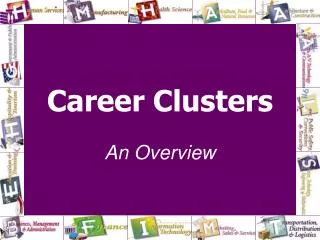
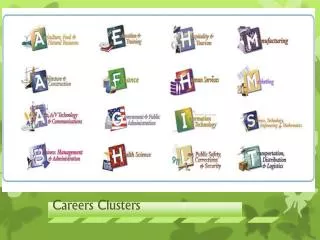
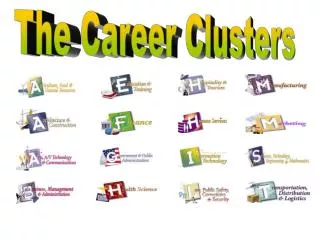
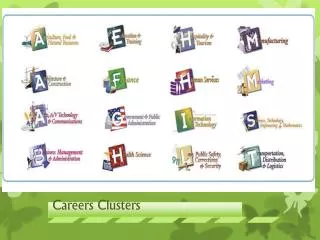
16 National Career Clusters Agriculture, Food and Natural Resources Architecture and Construction Arts, A/V Technology and Communications Business, Management and Administration Education and Training Finance Government and Public Administration Health Science
…and more Clusters Hospitality & Tourism Human Services Information Technology Law, Public Safety & Security Manufacturing Marketing, Sales & Service Science, Technology, Engineering & Math Transportation, Distribution & Logistics
Career Clusters: Goals • Prepare students for success in Careers (academic skills, technical skills, employability skills) • Support Economic Development and workforce training • Encourage Career Development (exploration/entry/change) • Improve transitions • Improve Academic Achievement (meet state requirements)
Pathways • Groupings of professions that require similar talents, knowledge and skills.
Occupational Specialties • Specific occupations organized by pathway within the Career Cluster • May not be exclusive to one Career Cluster
Organization of Knowledge and Skill Statements Grouped in 10 Topic Areas: • Academics • Communications • Problem Solving and Critical Thinking • Information Technology • Systems • Safety, Health and Environment • Leadership and Teamwork • Ethics and Legal Responsibility • Employability and Career Development • Technical Skills
Idaho’s Cluster Model • 6 Super Clusters • 16 National Clusters • Pathways • Occupations
Super Cluster ►Cluster Match Arts & Communications Health Care Agriculture & Natural Resources
Super Cluster ►Cluster Match Business & Management
Super Cluster ►Cluster Match Human Resources
Super Cluster ►Cluster Match Engineering & Industrial Systems
Career Clusters Implemented Through a Program of Study (POS) Individual Graduation Plan • Recommended sequence of courses • organized around Career Cluster Pathway(s) • grades 9-14/16, for academic, elective, and professional-technical offerings
Program of Study Components (Continued) • Articulated courses between high school and college and/or recognized industry certifications • Learning opportunities through student organizations and community opportunities
Benefits for Students and Parents • Relevance • academic achievement • Connections • school, college, workplace, life-long learning • Opportunities • multiple career pathways • College preparedness • less remediation/$ “Quit school? Quit School? You wanna end up like your father? A career lab rat?”
Benefits for Educators That Impact Industry • Connection between school and the 21st century workplace • Knowledge and skill statements for aligning curriculum • Common language with business
Benefits for Business and Workforce Development • Linked with labor market data • Skills gap identification • Knowledge and skills needed in the workplace • Common language with education • Curriculum input to education/ training providers
Career ClustersHow can they be used by business? • ….Promote economic development • ….Identify knowledge and skills needed in the workplace • ….Communicate training needs to education providers
Contacts & Resources • State Division of Professional- Technical Education • Ann Stephens, Associate Administrator • Sally Harris, Curriculum Coordinator • Kristi Enger, Career Guidance Coordinator • www.pte.idaho.gov • States Career Clusters Initiative • www.careerclusters.org