Hurricane Thermodynamics
This document delves into the thermodynamic principles underlying hurricanes, examining their physical structure and the dynamics of energy within. We highlight the costliest hurricanes, such as Katrina and Andrew, detailing their financial impacts and destructiveness. The influence of climate change and greenhouse gases on hurricane intensity is discussed, alongside innovative methods for storm mitigation, including the application of cryogenic coolants to weaken tropical cyclones. Key thermodynamic processes like Carnot engines provide insight into improving hurricane forecasting and understanding wind velocity variations.

Hurricane Thermodynamics
E N D
Presentation Transcript
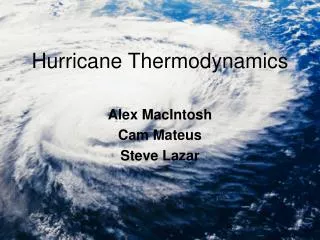
Hurricane Thermodynamics Alex MacIntosh Cam Mateus Steve Lazar
Costliest Hurricanes • Katrina – 2005 – $81 Billion • Andrew – 1992 – $26.5 Billion • Wilma – 2005 – $20.6 Billion • Charley – 2004 – $15 Billion • Difficult to study: immense power • About 48 of 80 tropical cyclones qualify in terms of intensity http://www.nhc.noaa.gov/Deadliest_Costliest.shtml
Physical Structure • Storms form in the tropics • Three main parts • The eye • Eyewall • Rainbands • Axisymmetric Vortex • Hydrostatic and Rotational Balance http://www.srh.noaa.gov/jetstream/tropics/tc_structure.htm
Carnot Engines • Thermodynamic disequilibrium • Four Sequences • Isothermal Expansion • Adiabatic Expansion • Isothermal Compression • Adiabatic Compression http://en.wikipedia.org/wiki/Atmospheric_thermodynamics
Equations • Efficiency of Carnot Engine • Carnot’s Theorem to predict maximum wind speed
Climate Change • Greenhouse gases and effects on hurricanes • Carnot’s Theorem: Temperature difference and intensity of hurricane • Adiabatic expansion increased • Greater wind velocity
How Temperature Variation Effects Wind Velocity When T1 = 25C, the Vmax is ~ 5.85 m/s When T1 = 30C, the Vmax is ~ 8.34 m/s This is a stunning 50% increase in the wind velocity!
How? • Apply a cryogenic coolant • Nitrogen gas • Carbon Dioxide • Air • Water • Transport and deliver coolant using • Plane • Ship • Barge Remotely Controlled?
Thermal Updrafts Strongest Thermal Updraft At the down tilt right region of Hurricane Apply Coolant There From Nat. Oceanic and Atmospheric Administration http://celebrating200years.noaa.gov/historymakers/Smagorinsky/hurricane_emily650.html
What? From www.fema.gov • Coolant does: • Decreases updraft temperature • Increase wind shear w/ large solid coolant pieces • Higher the wind shear---weaker the storm
Citations • Emanuel, K.A., The Theory of Hurricanes. Annu. Rev. Fluid Mech., 23 (1991) 179-196 • Tropical Cyclone Structure. [cited November 27, 2008]; Available from: http://www.srh.noaa.gov/jetstream/tropics/tc_structure.htm • Kondepudi, Dilip. Introduction to Modern Thermodynamics. John Wiley & Sons, Ltd, 2008. • Emanuel, K.A., Tropical Cyclones. Annu. Rev. Earth. Planet. Sci., 31 (2003) 75-104. • Atmospheric thermodynamics. [cited November 26, 2008]; Available from: http://en.wikipedia.org/wiki/Atmospheric_thermodynamics. • Mooney, C. The Truth About the 2007 Atlantic Hurricane Season. 2007 [cited October 26, 2008]; Available from: http://www.thedailygreen.com/environmental-news/blogs/hurricanes-storms/7889. • O’Keefe, D.R., Hurricane Abatement Method and System, U.P.T. Office, Editor. 2007: USA