Mastering Punctuation: Colons and Semicolons Explained
This guide explores the correct usage of colons and semicolons in writing. Learn to use colons for lists, examples, and formal greetings, while understanding the nuances of semicolons for closely related sentences. Discover tips on common mistakes and enhance your punctuation skills to improve clarity in your writing. With examples, you'll easily grasp when to apply each punctuation mark effectively. Elevate your grammar knowledge and ensure your writing conveys your ideas clearly and professionally.

Mastering Punctuation: Colons and Semicolons Explained
E N D
Presentation Transcript
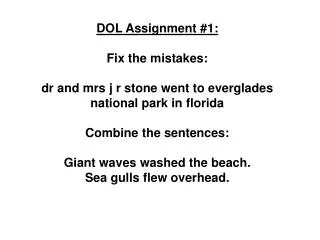
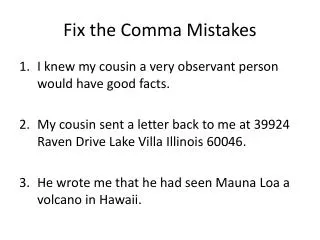
Fix the Comma Mistakes • I knew my cousin a very observant person would have good facts. • My cousin sent a letter back to me at 39924 Raven Drive Lake Villa Illinois 60046. • He wrote me that he had seen Mauna Loa a volcano in Hawaii.
Topic Explanation • Use a colon when you want to say “for example” or “such as”. Ex“: There’s only one sport for me: alligator wrestling. Ex-: My favorite sports are the following: baseball, basketball, soccer, golf. WRONG: The ingredients are: flour, sugar, eggs, milk. Use a colon before some lists. Do not use colons after verbs:
Topic Explanation • Ex; It’s 12:15 P.M. • Ex: Dear Senator Kirkpatrick: • Ex: Caution: Slippery floor. • Use colons with expressions of time • Use in the greeting • of a formal letter • Use a colon after the words “caution”, “wanted”, or “note”
Topic Explanation Use between two sentences that are very closely related • Ex: My family is Jewish; we celebrate Chanukah but not Christmas. • Ex: I bet you thought you wouldn’t have to learn another semicolon rule; however you were wrong. • Use a semicolon before however and similar words (These are called conjunctive adverbs) Also, besides, indeed, otherwise, therefore, in fact, meanwhile, in addition, next, still, finally, earlier, certainly, nevertheless Conjunctive adverbs
Explanation Topic • Ex: Wesley likes baseball, football, and hockey; Brian likes swimming, tennis, and soccer; Torilikes yoga, biking, and golf. • Use semicolons between clauses or phrases that contain lots of commas.