The Solar System
Dive into the wonders of our solar system with this comprehensive overview of the eight planets and our Sun. From the scorching surface of Mercury to the icy depths of Neptune, each planet reveals its unique characteristics. Discover how the Sun, a massive ball of gas, fuels our solar system with light and energy. This presentation provides fascinating facts about each planet's size, distance from the Sun, and intriguing features, including the mysterious dwarf planet, Pluto. Join us on this celestial adventure!

The Solar System
E N D
Presentation Transcript
Haley Biggins, Random PowerPoint The Solar System
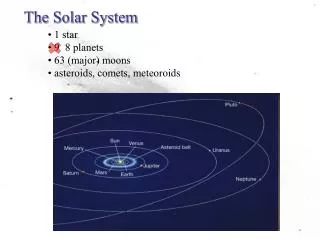
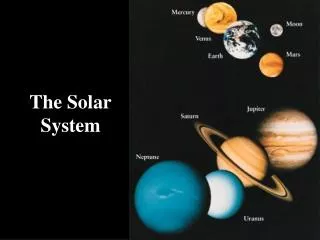
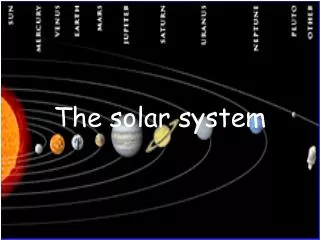
The Planets, From Closest To the Sun • Mercury • Venus • Earth • Mars • Jupiter • Saturn • Uranus • Neptune Citing - http://cse.ssl.berkeley.edu/AtHomeAstronomy/act09_planet_list.html
Our Sun • In the center of our solar system • Provides light, heat, and energy • Gaseous • The suns diameter is about 432,000 miles • Over 1 billion stars in the galaxy • Has a temperature of about 10,000 degrees Fahrenheit
Our Sun • The sun is magnetic • Born about 4.6 billion years ago • 99.8% of the mass in our solar system • The average density is 90 lbs./ square foot Citing - http://www.nasa.gov/worldbook/sun_worldbook.html#backToTop
The Planets, Mercury • Diameter of 3032 miles across the equator • It is the fastest planet to move around the sun in its orbit • Has the slowest rotation except for Venus • Travels about 30 miles per second Citing - http://www.nasa.gov/worldbook/mercury_worldbook.html
The Planets, Venus • Similar to Earth in size • When Venus is at its nearest point to Earth, it can be seen all day • Venus has the most circular orbit around our sun • 55 degrees F on the surface, but up to 870 degrees F of the actual planet • The mass is about 4/5th of Earth’s Citing - http://www.nasa.gov/worldbook/venus_worldbook.html
The Planets, Earth • Has life • Ranked 5th in size • About 93 million miles from the sun • Earth takes 365 days 6 hours 9 minutes 9.54 seconds to circle the sun once • The distance around Earth's orbit is 584 million miles Citing - http://www.nasa.gov/worldbook/earth_worldbook.html
The Planets, Mars • The fourth planet from the sun • About 4.6 billion years ago • Nicknamed from the ancient god of war • Water once flowed on the surface of Mars • Water may still live in cracks under the surface • Vast amounts of ice under the surface
The Planets, Jupiter • About 11 times bigger than Earth • Usually brighter than most stars and planets, except Venus • Named after the king of Roman gods • A giant ball of gas and liquid with little, or no, solid surface • Travels in an elliptical orbit • Completes one orbit every 4,333 days (12 Earth Years) • Large mass but very low density
The Planets, Saturn • Has 7 flat rings around it • Diameter is almost 10 times that of Earth’s • Named it the Roman god of agriculture • It takes almost 30 years to orbit the sun • Lower density than any other planet • Has 25 satellites and numerous other smaller ones that orbit around with the rings of Saturn
The Planets, Uranus • 7th planet from the sun • Takes light 2 hours and 40 minutes to travel to Uranus • British astronomer William Herschel discovered it in 1781 • Rotates on a horizontal axis • Has 21 known satellites • Strong magnetic field • 1,784,860,000 miles from the sun
The Planets, Neptune • Clouds surround the planet • Every 248 years Pluto moves inside Neptune's orbit for about a 20-year period • The diameter at the equator is four times bigger than Earth’s • 1 Day – 16 hours and 7 minutes • Made up of hydrogen, helium, water, and silicates
What About Pluto?!?!?! Picture of Pluto from the Hubble Telescope • Considered a Dwarf Planet • Last planet in our Solar System • About 3,647,240,000 miles from the sun • Comes inside Neptune’s orbit about for 20 Earth Years every 248 Earth Years • Astronomers know little because it is so far away from Earth and the sun • Thin atmosphere