Future Geospatial Coordination: Key Issues and Insights from the NGAC Meeting
This document summarizes critical discussions from the National Geospatial Advisory Committee (NGAC) meeting held on April 1-2, 2014. It identifies issues related to tribal geospatial matters, aerial imagery project coordination with military installations, and the role of FirstNet in data coordination. Additionally, it highlights historical executive orders shaping U.S. geographic governance, the need for better coordination of geospatial information, and strategies for fostering collaboration among agencies to enhance the National Spatial Data Infrastructure (NSDI). Insights also address how to transition GIS from an expense to an investment.

Future Geospatial Coordination: Key Issues and Insights from the NGAC Meeting
E N D
Presentation Transcript
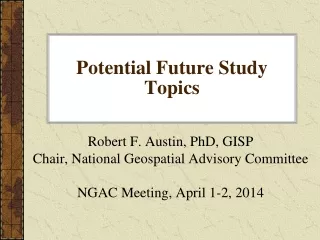
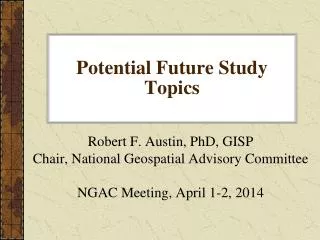
Potential Future Study Topics Robert F. Austin, PhD, GISP Chair, National Geospatial Advisory Committee NGAC Meeting, April 1-2, 2014
Issues Identified April 1, 2014 • DOI/USDA Tribal geospatial issues – Frank Harjo and David Wyatt • Coordination of aerial imagery projects with military installations – Gary Thompson and Michele Motsko • FirstNet – Dan Cotter
Data Coordination Summary • U.S. Board on Geographic Names - Executive Order 28 (1890) • U.S. Geographic Board - Executive Order 493 (1906) • Board of Surveys and Maps - Executive Order 3206 (1919) • 1920-1936, six Executive Orders issued amending Executive Order 3206 • Executive Order 9094 (1942) • Bureau of the Budget/Office of Management & Budget Circular A-16
Data Coordination Summary • Executive Order 12906 (1994) • Executive Order 13286 (2003) • Geospatial Information: Better Coordination Needed to Identify and Reduce Duplicative Investments - GAO-04-703 (2004) • OMB Memorandum M-11-03 Supplementary Guidance to OMB Circular A-16 (2010) • Geospatial Information: OMB and Agencies Need to Make Coordination a Priority to Reduce Duplication - GAO-13-94 (2012)
Lessons Learned from 124 Years • Coordination policies have deep roots • Policy goals have remained consistent • Coordination of geographic data acquisition and dissemination is important • Ways to improve the effectiveness of often stove-piped organizational structures • Ways to stimulate cross agency coordination and collaboration • Ways to coordinate and foster organizational changes that to benefit the NSDI mission
NSDI Sustainability: Beginning a Conversation • What NSDI sustainment look like in the future? • How can (more) agencies be encouraged to include GIS in their strategic vision? • Calling it an asset doesn’t make it an asset: how do we move GIS from an expense to an investment?
What Changes Will Affect Us? • Planet Labs remote sensing platforms • Pico cells and privacy • ???