Ethical Dimensions of Technosocial Networks: A Spectrum of Recursive Depth
180 likes | 296 Vues
This exploration delves into the ethical implications of technosocial networks through the concept of recursive depth. It examines three pivotal transformations: the public/proprietary spectrum illustrated by the evolution of open-source software, particularly with the GNU General Public License and its impact on code sharing; the online/offline spectrum highlighted by innovative applications like the Water Quality Management System; and the social power spectrum that empowers under-represented groups. The analysis reveals deep, interconnected layers within these transformations and their implications for ethical technology use.


Ethical Dimensions of Technosocial Networks: A Spectrum of Recursive Depth
E N D
Presentation Transcript
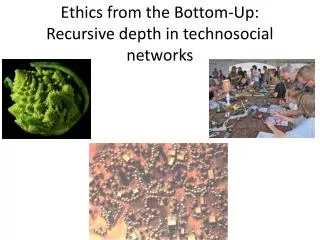
Ethics from the Bottom-Up:Recursive depth in technosocial networks
Three dimensions of recursive depth Transformations along the public/proprietary spectrum -- Open Source Software Transformations along the online/offline spectrum -- Arduino Transformations along the social power spectrum – Under-represented groups empowered
Innovation Cascades 1983: Stallman’s GNU uses General Public License (GPL) keeps variants in the public domain. 2000: van Rossum’s Python License allowed proprietary products from modified versions 2003: Holovatyand Willison create web application server Django, releasing it as open source. 2010: (ICOMMS) at U. Cape Town combine Djangowith Open Source cell phone app: Water Quality Management System for low-income communities
Deep layers versus shallow chainsDeep but also broadTransformations across a spectrum