The Political, Religious, and Economic Landscape of Ancient Sumer
Ancient Sumer, located in the Fertile Crescent, was characterized by its complex political structure, featuring kings with military and religious duties alongside elected officials, suggesting democratic elements. The civilization was heavily reliant on river systems for agriculture, facing challenges in water supply for dry farming. Sumerians believed in a mix of gods and animism, with each city honoring its own patron deity. Innovations such as the seeder plow and cuneiform writing marked their technological advances, and a structured social hierarchy defined their economy and daily lives.

The Political, Religious, and Economic Landscape of Ancient Sumer
E N D
Presentation Transcript
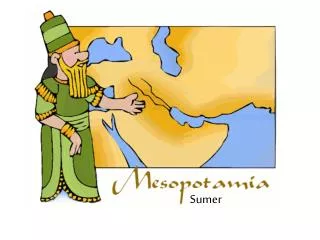
Sumer, Mesopotamia By Logan Chamberlain, Zanon Ross and Cole Dahring
Political • The States of Sumer were seemed to be ruled by kings. Their job included military and religious responsibilities. • They were ruled by kings but it seemed like they had a form of democracy, because they elected officials to run government
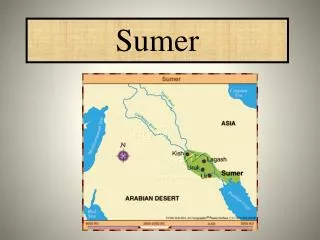
Interaction w/ Environment • Depended on rivers to sustain agriculture, not enough water for dry farming • Was located in Fertile Crescent which created great agriculture
Religion We don’t know exactly what there religion was but we believe that they believed and gods but also animism. Animism defined by thefreedicti- onary.com is the belief in the existence of individual spirits that inhabit natural objects and phenomena. Every city had its own patron god or goddess, but all believed in four main gods.
Arts and Sciences • made cave painting of animals • statues of religious symbols • objects of state, tablets recording taxes • personal objects, objects that people treasured
Technology • Invented seeder plow • Invented cuneiform • Developed a means of irrigation • Developed a form of sanitation of water
Economics • Paid taxes in the form of goods • Such as bundles of reed and maize • Agricultural people • People sold goods and agricultural products • Sold lumber
Social Structure • Slaves are on the bottom • Commoners are next • Then merchants and artisans • Then scribes • Next is priests • Finally the king is the highest person in social order
http://www.youtube.com/watch?v=84y2q4giihY 11 September 2012 <http://www.dl.ket.org/humanities/connections/class/ancient/mesopart.htm>. 11 September 2012 <http://www.slideshare.net/coldcanada/mesopotamian-social-structure-11827004>. Ancient Mesopotamia: Science & Inventions. 12 September 2012 <http://oi.uchicago.edu/OI/MUS/ED/TRC/MESO/science.html>. Strayer, Robert W. Ways of he World. Boston: Bedford, St. Martins, 2011. Zantonavitch, Kyrel. Sumerian Philosophy. 12 September 2012 <http://rebirthofreason.com/Articles/Zantonavitch/Sumerian_Philosophy.shtml>.